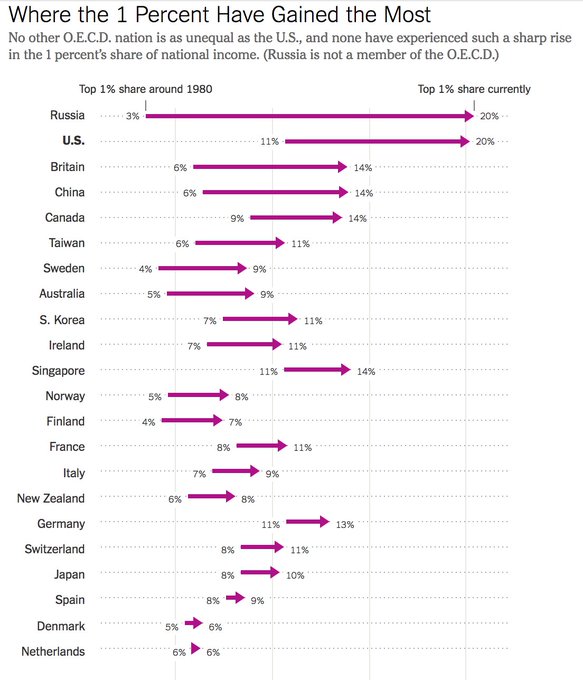
Share of national income held by top 1%
Russia 20%
US 20%
UK 14%
China 14%
Canada 14%
Germany 13%
Sweden 9%
Australia 9%
Norway 8%
Denmark 6%

26 noviembre, 2017
por Felipe Sahagún
Sin comentarios
Share of national income held by top 1%
Russia 20%
US 20%
UK 14%
China 14%
Canada 14%
Germany 13%
Sweden 9%
Australia 9%
Norway 8%
Denmark 6%
24 noviembre, 2017
por Felipe Sahagún
Sin comentarios

24 noviembre, 2017
por Felipe Sahagún
Sin comentarios
24 noviembre, 2017
por Felipe Sahagún
Sin comentarios

Congress Asked for an Assessment of the War on Al-Qaeda. Here’s What We Told Them
The Secretary of Defense, in coordination with the Secretary of State and the Director of National Intelligence, shall provide for the conduct of an independent assessment of the effectiveness of the United States’ efforts to disrupt, dismantle, and defeat Al-Qaeda … since September 11, 2001.

24 noviembre, 2017
por Felipe Sahagún
Sin comentarios

ISIS’ Intelligence Service Refuses to Die -Why the Emni Isn’t Going Away
Foreign Affairs (Nov 22, 2017)
In the darkness of a Mosul safe house in which ten Iraqi soldiers slept, bluish light still emanated from the mobile devices of two intelligence officers busy locating suicide cars, IEDs, and Islamic State (ISIS) bases, and tracking down the names of ISIS members. Providing that information were civilians deep in ISIS territory. On the other side of the battle, the same process was happening in reverse. And those operations were, in many ways, far more sophisticated. Even now that the terrorist organization is disintegrating, its intelligence bureau still presents a major challenge.
THE INFORMATION WAR
For many of the civilians providing information about ISIS to Iraqi authorities, doing so was their way of fighting back against a miserable situation. “So many people in Mosul wanted to cooperate with us because they wanted revenge [against] ISIS for killing their family members,” one Iraqi Army intelligence officer told us. For others, the job was purely for material benefit—the payouts whose size depended on the information provided.
24 noviembre, 2017
por Felipe Sahagún
Sin comentarios

Opinion | Telling the Truth About the Cost of War: As civilian casualties appear to rise, the American military is not acknowledging the extent of the problem. @nytimes editorial

America’s Military Doesn’t Have Enough Money to Do Its Job
Donald Trump promised a bigger defense budget, but the Pentagon is still waiting.
Sherlock Holmes once solved the mystery of a disappearing racehorse by noting “the curious incident of the dog in the night-time.” But, a Scotland Yard detective objected, “The dog did nothing in the night-time.” Holmes’s laconic reply: “That was the curious incident.” Today, in Washington, the dog that isn’t barking is the defense budget. It is the biggest issue that no one — at least no one outside the defense policy community‚ is talking about.


