Relaciones Internacionales – Comunicación Internacional

14 marzo, 2025
por Felipe Sahagún
Sin comentarios

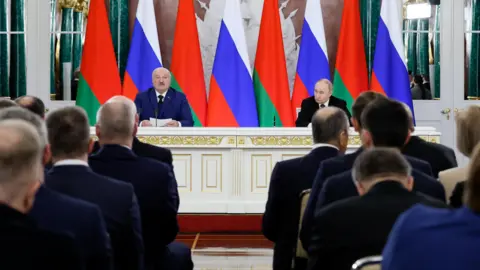
BBC Verify: What does Putin video tell us about the battle for Kursk?

Russia's President Vladimir Putin and Belarus' President Alexander Lukashenko attend a press conference

Russian forces have been steadily retaking territory in the Kursk region, the area of Russia that Ukraine attacked in 2024. It comes as the US tries to get Russia to agree to a ceasefire in the three-year long conflict.

BBC Verify’s Nick Eardley has been looking at the situation.

Verification: Benedict Garman, Kayleen Devlin, Thomas Spencer, Yaroslava Kiryukhina and Fridon Kiria

Motion graphics: Jacqueline Galvin

LINK


13 marzo, 2025
por Felipe Sahagún
Sin comentarios

Trump Tariff Trucker (Atlantic Council)

Trump Tariff Tracker

The second Trump administration has embarked on a novel and aggressive tariff policy, citing a range of economic and national security concerns. Our GeoEconomics Center’s new tracker monitors the evolution of these tariffs and provides expert context on the economic conditions driving their creation—along with their real-world impact.

Explore the full tracker on our site. Continue leyendo →

13 marzo, 2025
por Felipe Sahagún
Sin comentarios

De qué va la guerra en Ucrania (Alberto Sicilia)

Imagen

Imagen

Principia Marsupia@pmarsupia

Llevamos 3 años y se sigue sin entender de qué va la guerra en Ucrania. Esta guerra no va de la OTAN, ni del Donbás, ni de los depósitos de minerales. Todos esos son temas secundarios frente al asunto principal. Y nadie ha explicado el asunto esencial mejor que Putin /

9:33 p. m. · 13 mar. 2025

Continue leyendo →

13 marzo, 2025
por Felipe Sahagún
Sin comentarios

Made in China 2025

Carol Yang in Beijing

China’s ambitious “Made in China 2025” industrial strategy has put the country on track to become a global leader in smart manufacturing within the next few years, though breakthroughs are still needed in several bottleneck technologies, according to a new report by Beijing’s Renmin University of China.

The Made in China 2025 project, launched a decade ago, aimed to propel China to the forefront of a slew of hi-tech industries, including aerospace, electric cars, robotics and telecommunications.

..MORE


13 marzo, 2025
por Felipe Sahagún
Sin comentarios

El mundo en 2025 (Robert Kaplan)

El periodista y analista político estadounidense Robert D. Kaplan.

GEOPOLÍTICA

Robert D. Kaplan: «Sin el liderazgo de EEUU Europa sucumbiría, sería incapaz de coordinarse»

El analista político estadounidense publica ‘Tierra baldía’, un ensayo trufado de referencias filosóficas y literarias en el que a través de una lúcida mirada al siglo XX aborda los grandes retos de un mundo en crisis permanente. «Mi mayor temor es la pérdida de poder del individuo, algo que está logrando la tecnológica democracia de masas actual»

 
Actualizado 

Por mucho que suene a tópico, las lecciones del pasado suelen encerrar advertencias útiles y descifrables, sólo basta con prestar atención a las señales. Así opina el controvertido periodista, analista político y ensayista Robert D. Kaplan (Nueva York, 1952) al comparar la situación global actual con la República de Weimar, el efímero y endeble Estado que precedió al Tercer Reich, convertido desde hace décadas en parábola de una sociedad que no es consciente de su propia necesidad de orden y poder estatal y, por lo tanto, está condenada a ser castigada por el poder estatal en su forma más vengativa y cruel.

La comparación de el actual Estados Unidos con Weimar es constante desde la segunda victoria de Donald Trump, pero en su nuevo ensayo, Tierra baldía (RBA) -en el que el título del poema de T. S. Eliot es también metáfora y una más de las muchas referencias literarias– el pensador estadounidense, quien afirmaba hace no muchos años que «si Donald Trump es reelegido, el orden mundial liberal puede estar en serio peligro», escribe: «los juerguistas de Weimar, enamorados de la anarquía y las fiestas del fin del mundo, no tenían idea de lo que les aguardaba. Cuanto más abyecto es el desorden, a menudo más extrema es la tiranía que sigue«.

…MORE


13 marzo, 2025
por Felipe Sahagún
Sin comentarios

5 Years After Covid-19 (allAfrica)

Imagen

Five years after the WHO declared COVID-19 a pandemic, the world has made significant strides in managing the virus, with vaccines and acquired immunity reducing severe outcomes.

Detection, prevention, and response systems have also improved, and global preparedness was enhanced by initiatives such as the WHO Hub for Pandemic and Epidemic Intelligence, the Pandemic Fund, and the mRNA technology transfer hub.

However, challenges remain, including fragile supply chains, misinformation, and unequal vaccine distribution. Many countries still struggle to sustain health systems and workforce capacities. Long Covid continues to affect millions, and the pandemic has exposed strengths and weaknesses in global preparedness. 

The world must invest in research, strengthen health systems, and ensure equitable access to vaccines and treatments to prepare for the next pandemic.

Related

 5 Years Since Covid Was Declared a Pandemic, We’re Still Poorly Prepared for the Next One

After Covid-19, Is the World Ready for the Next Pandemic?

Three Memorable Ways the Covid Pandemic Shaped Black Music – Five Years On

Long Covid – ‘I Don’t Think Govts Are Taking It Seriously Enough’

Grim News on Pandemic Preparedness

From Covid to today: five years that changed our money