Relaciones Internacionales – Comunicación Internacional

30 marzo, 2024
por Felipe Sahagún
Sin comentarios

Why the world is not fair (Yuval Noah Harari with Ian Bremmer)

In 2024, both Americans and Israelis find themselves at a turning point, with complex questions of national identity, democracy and historical justice looming large.

In the midst of Israel’s war with Hamas and on the eve of the US Presidential elections, Yuval Noah Harari publishes a new children’s book that discusses the origins of injustice and inequality: Unstoppable Us, Part 2: Why the World Isn’t Fair. In our fragmented world it seems more difficult than ever to debate such questions – but it is also more important than ever. How can people in the Middle East, the USA and elsewhere tell the difference between myth and reality?

Where is the intersection point between justice and peace? Hear Harari, one of today’s most renowned storytellers of human history and 21st century technology, tackle these questions and more – offering an incisive analysis that connects the collective decisions we make today to the national and global order of tomorrow. Recorded March 3, 2024 at 92nd Street Y, New York.

30 marzo, 2024
por Felipe Sahagún
Sin comentarios

Fareed Zakaria on ‘Age of Revolutions’ and the lessons of history for today

Fareed Zakaria, a CNN host, a Washington Post columnist and a veteran foreign policy observer, has written a new book that examines how revolutions – past and present – often provoke backlash. Zakaria joins Post columnist Max Boot to discuss his book, “Age of Revolutions” and the lessons history holds for today.

Washington Post Live is the newsroom’s live journalism platform, featuring interviews with top-level government officials, business leaders, cultural influencers and emerging voices on the most pressing issues driving the news cycle nationally and across the globe. From one-on-one, newsmaker interviews to in-depth multi-segment programs, Washington Post Live brings The Post’s newsroom to life on stage. Subscribe to The Washington Post on YouTube: https://wapo.st/2QOdcqK


29 marzo, 2024
por Felipe Sahagún
Sin comentarios

The Israel-Hamas war (FT)

The Israel-Hamas war

LINK TO VIDEO

10101:25 / 56:58

Mar 21, 2024

Is there a road to peace?

Our panel will cover the following topics and take your questions:

  • What will it take to bring a lasting ceasefire in Gaza?
  • Is the Biden administration able to secure a change of course by Israel as long as prime minister Benjamin Netanyahu is kept in power by far-right politicians opposed to any deal with Palestinians? 
  • How much damage has America’s backing for Israel done to Washington’s standing in the world – and to president Biden’s domestic political support?
  • Can the divided Palestinian factions really come together in a postwar settlement in Gaza capable of commanding international and Palestinian confidence?
  • Is a two-state solution for Israel’s conflict with Palestinians still viable as the route to a lasting peace?
  • What is the role of Israel’s Arab neighbours in bringing peace to and rebuilding shattered Palestinian communities?
  • What are the chances of the war spreading to Lebanon – and if so what would Iran do?
  • Plus many more audience questions.

James Shotter Panelist

Jerusalem correspondent @ Financial Times

James Shotter has been the Jerusalem correspondent for the FT since 2022. He was previously central Europe correspondent, was posted to Frankfurt covering German finance, and before that to Zurich as Switzerland and Austria correspondent. He joined the FT as a leader writer in 2010.

Raya Jalabi Panelist

Middle East correspondent @ Financial Times

Raya Jalabi is the FT’s Middle East correspondent, covering Iraq, Syria and Lebanon from her base in Beirut. Before joining the FT in 2022, she covered Saudi Arabia and Iraq for Reuters, and was a news editor and reporter at The Guardian in New York.

Edward Luce Panelist

US national editor and columnist @ Financial Times

Edward Luce is the US national editor and columnist at the Financial Times. Before that he was the FT’s Washington Bureau chief. Other roles have included South Asia bureau chief, Capital Markets editor, and Philippines Correspondent. Luce was previously the speechwriter for the US Treasury Secretary, Lawrence H. Summers, in the Clinton administration. He is the author of three highly acclaimed books, The Retreat of Western Liberalism (2017), Time to Start Thinking: America in the Age of Descent (2012), and In Spite of the Gods: The Strange Rise of Modern India (2007). He appears regularly on CNN, NPR, MSNBC’s Morning Joe, and the BBC. He is also the author, along with colleague Rana Foroohar, of the Swamp Notes newsletter, which covers the intersection of money, power, and politics in America.
Read more

Heba Saleh Panelist

Cairo Correspondent @ Financial Times

Heba Saleh is the FT Cairo correspondent. She covers political, economic and business news across all of North Africa. She has been full time with the FT since 2008. Before that she worked for the BBC in both London and Cairo as a radio correspondent and radio producer. She has written for the Economist, the Irish Times and Middle East International.

Alec Russell Moderator

Foreign editor @ Financial Times

Alec Russell is the FT’s Foreign Editor, responsible for overseeing our network of foreign correspondents and our coverage of great global themes. He was the editor of FT Weekend from 2016-2023. During his tenure, it won a series of awards including European weekend newspaper of the year and UK weekend newspaper of the year. He also launched the FTWeekend festival in London and then in Washington. He was previously the FT’s news editor and also the opinion editor. A long-time former foreign correspondent, he has reported from Eastern Europe, sub-Saharan Africa, the Middle East and Washington, winning a number of awards. He has written three books. The latest is After Mandela: the battle for the soul of South Africa.


28 marzo, 2024
por Felipe Sahagún
Sin comentarios

Rumbo al Antropoceno (Foro de Foros, Madrid)

Tanto hemos forzado las costuras de nuestro planeta que hemos acabado generando algo inaudito en sus 4.500 millones de años de historia: que una especie viva lleve a la Tierra al borde de un cambio de época geológica. Hay que esforzarse mucho y por mucho tiempo para cambiar el ciclo vital de un planeta. Pero los humanos somos tantos, y tan voraces, que vamos camino de conseguirlo. De hecho, un grupo de influyentes geólogos sostienen que esto ya ha ocurrido, y han denominado Antropoceno a esta nueva era. Sin embargo, en una disputada y polémica votación para decidir si en efecto la Tierra ha entrado en una nueva era climática o todavía no, la mayoría de los expertos votantes decidieron que no se dan todos los requisitos para afirmar tal extremo.

La votación al más alto nivel fue reñida y tensa. Se produjo este mes de febrero. Lo que había en juego era sin duda trascendental en términos científicos e históricos. Había que dar respuesta a 15 años de investigación de un grupo de geólogos, el llamado Grupo de Trabajo del Antropoceno (GTA, o AWG en sus siglas en inglés), que desde el año 2009 ha recopilado pruebas de nuestra impronta devastadora sobre el planeta. Pesticidas, microplásticos, particulas contaminantes del carbón y el petróleo, y un largo etcétera de residuos y manipulaciones geológicas (como la devastación de entornos mineros y forestales) que, unidas y persistentes en el tiempo, nos invitan a pensar que la Tierra de hoy no es la misma Tierra de hace cien años.

…MORE


28 marzo, 2024
por Felipe Sahagún
Sin comentarios

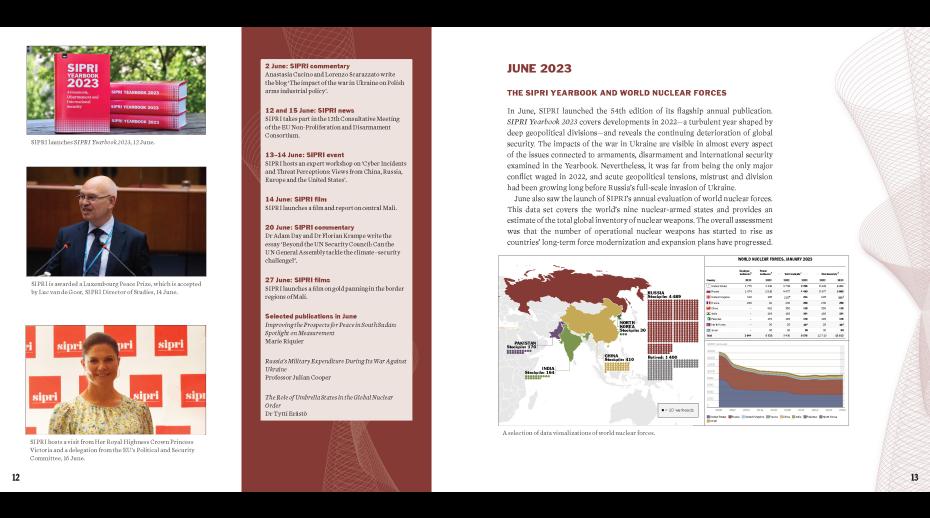
Annual Review 2023 (SIPRI)


Annual Review 2023

SIPRI is pleased to launch Annual Review 2023, which takes a retrospective look at the Institute’s activities and achievements during the year.

As the international system grappled with a myriad of challenges in 2023, SIPRI maintained a key role in providing data and analysis. With the Russia–Ukraine war and the Israeli–Palestinian conflict impacting issues from ecology and militarization to arms control, SIPRI’s contribution to the global conversation became increasingly vital.

Annual Review 2023 is structured into themes that cover a wide scope of security-focused topics. Each two-page spread describes SIPRI’s work on these topics and includes a list of activities ranging from publications and commentary pieces to films and events. Topics include: the intersection of food, security and conflict; the war in Ukraine; global armaments; conflict and security in West Africa; and artificial intelligence and cybersecurity. It also includes a detailed breakdown of SIPRI’s global media impact which, in 2023, saw coverage in over 70 000 news articles (compared to 59 000 in 2022) across 140 countries. 

Click here to download SIPRI’s Annual Review 2023.


28 marzo, 2024
por Felipe Sahagún
Sin comentarios

US cyber force

Late last year, the commander of U.S. Cyber Command observed that the current state of U.S. military cyber organization is unsustainable. “All options are on the table,” he said, “except the status quo.” The existing structures have led to recruitment challenges, inconsistencies in compensation and service requirements, and personnel with inadequate training and support. Bipartisan members of Congress have for a decade expressed deep concern about the inability of the existing military services to recruit, train, and equip sufficient personnel to meet growing cyber challenges.

…MORE

Report