Relaciones Internacionales – Comunicación Internacional

17 noviembre, 2023
por Felipe Sahagún
Sin comentarios

America and the world (The Economist series)

Ukraine’s counter-offensive has not gone to plan. By the end of September, President Volodymyr Zelensky’s troops had recaptured just 0.25% of the territory occupied by Russian forces in June.

The Economist’s editors sat down to discuss prospects for the war, analyse the changing roles of America and nato, and consider how leaders in the global south have reacted to the conflict. Sharing insights from their recent meetings with President Zelensky and other high-level decision makers in Ukraine, our experts assess the latest military and diplomatic developments.

With Zanny Minton Beddoes, Shashank Joshi, Anton La Guardia and Arkady Ostrovsky.

…MORE


On october 2nd, five days before Hamas militants attacked Israel, The Economist’s geopolitics experts sat down to consider the future of international relations.

During this live event we talked about China’s strengthening ties with Russia. We also examined how America’s allies view its global leadership and discussed how America’s presidential election next year might change their assessment.

With Zanny Minton Beddoes, Shashank Joshi, David Rennie and Alice Su.

…MORE


17 noviembre, 2023
por Felipe Sahagún
Sin comentarios

Ukraine war: what does victory look like? (The Economist)

Ukraine’s counter-offensive has not gone to plan. By the end of September, President Volodymyr Zelensky’s troops had recaptured just 0.25% of the territory occupied by Russian forces in June.

The Economist’s editors sat down to discuss prospects for the war, analyse the changing roles of America and nato, and consider how leaders in the global south have reacted to the conflict. Sharing insights from their recent meetings with President Zelensky and other high-level decision makers in Ukraine, our experts assess the latest military and diplomatic developments.

With Zanny Minton Beddoes, Shashank Joshi, Anton La Guardia and Arkady Ostrovsky.

…MORE


17 noviembre, 2023
por Felipe Sahagún
Sin comentarios

Well red: inside The Economist’s language and style

Employ a simple and straightforward style

Clarity of writing usually follows clarity of thought.” So begins The Economist’s in-house style guide, issued to all its journalists and, since the 1980s, sold to the public. The new, updated edition loosens strictures yet retains tradition.Our editors reflect on how to retain the soul of a publication while changing the style in which it is written, and reveal some of the dos and don’ts that help them improve their own writing.With Charlotte Howard, Lane Greene and John Peet.

—MORE


16 noviembre, 2023
por Felipe Sahagún
Sin comentarios

The world we’re living in (Timothy Garton Ash, Guardian)

Imagen

Wed 15 Nov 2023 09.00 CET

As the leaders of the world’s two superpowers, the US and China, hold a summit meeting in San Francisco, many observers hark back to grand bipolar simplicities. A new cold war! The west versus the rest! Democracy versus autocracy! Let’s woo the global south! But the great Swiss historian Jacob Burckhardt warned us always to beware of the terribles simplificateurs, the frightful simplifiers. The beginning of wisdom is to understand that we now live in a world fragmented between multiple great and middle powers who do not divide simply into two camps.

The results of an ambitious round of global polling, released today, help us to understand this new world disorder. Conducted for the European Council on Foreign Relations and an Oxford University research project on Europe in a Changing World that I co-direct, this is the second time we have surveyed what we call in shorthand the Citrus countries: China, India, Turkey, Russia and the United States. This autumn we added to them five other major non-European countries – Saudi Arabia, Indonesia, South Africa, Brazil and South Korea – as well as covering 11 European countries.

…MORE


15 noviembre, 2023
por Felipe Sahagún
Sin comentarios

Record increase in water-related violence in the world (Guardian)

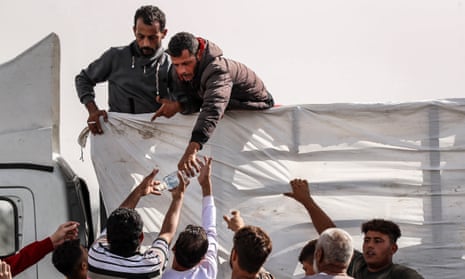
Water bottles are distributed in Gaza City on 11 November amid a clean water shortage.

Water bottles are distributed in Gaza City on 11 November amid a clean water shortage. Photograph: Anadolu Agency/Anadolu/Getty Images v @guardian

As water becomes a weapon of war, we must focus on cooperation and peace

 
Wed 15 Nov 2023 14.00 CET
 
n recent months, the world has been bombarded with reports of attacks on major dams and civilian water systems in Ukraine, water being used as a weapon during the violence in Gaza and the West Bank, unrest and riots in India and Iran over water scarcity and drought, and conflicts between farmers and herders in Africa over land and water sources. Our limited and precious freshwater resources have become triggers, weapons and casualties of war and conflict.

Continue leyendo →