Relaciones Internacionales – Comunicación Internacional

25 abril, 2023
por Felipe Sahagún
Sin comentarios

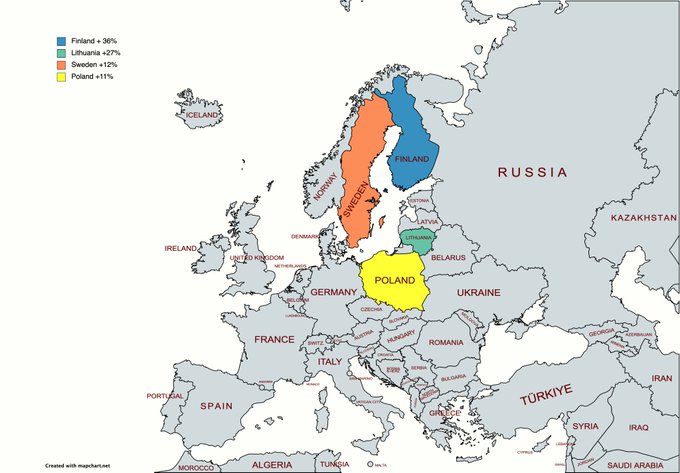
Germany’s Zeitenwende after one year


Imagen


Imagen

 
Sergej Sumlenny@sumlenny

24 abril, 2023
por Felipe Sahagún
Sin comentarios

Iraq since the invasion: 20 years in SIPRI data

The Turkish restaurant, Iraqi protests 2019. Photo: Majed/Wikimedia

Pieter D. Wezeman, Lauriane Héau, Dr Diego Lopes da Silva, Lorenzo Scarazzato and Timo Smit

Twenty years ago this month, a multinational coalition led by the United States and the United Kingdom invaded Iraq. In the words of US President George W. Bush, the aim of the invasion was ‘to disarm Iraq of weapons of mass destruction, to end [Iraqi President] Saddam Hussein’s support for terrorism, and to free the Iraqi people’.

On 20 March 2003, a massive multinational coalition force invaded Iraq under Operation Iraqi Freedom. After three weeks of an intensive air and ground campaign, the Iraqi capital, Baghdad, fell, and with it Saddam’s Ba’athist regime. Shortly afterwards, the Coalition Provisional Authority decided to disband the Iraqi Army. No weapons of mass destruction were ever found.

Estimates of civilian casualties of the war vary, but are generally in the hundreds of thousands. Many more people have been injured or displaced since the invasion. A 2005 constitution set in place a system of parliamentary democracy, with formal power-sharing arrangements between the country’s main ethno-sectarian groups. The Iraqi state formally took over responsibility for security in 2009, after which the coalition troop presence was gradually reduced from around 131 000 in 2009 to zero by the end of 2011.

…MORE


24 abril, 2023
por Felipe Sahagún
Sin comentarios

Food security in South Sudan (SIPRI)

SIPRI is pleased to launch a new film about the complexity of the food security crisis in South Sudan and the efforts needed to build stability and peace in a context of climate change impacts and intercommunal violence. In September, SIPRI released a series of video interviews with local people and humanitarian workers in South Sudan’s Jonglei State, exploring their perceptions of food security, violence and development challenges. ‘Food security and why it matters for peace in South Sudan’ mixes extracts from those interviews with new footage and graphics.

24 abril, 2023
por Felipe Sahagún
Sin comentarios

Global military expenditure in 2022 (SIPRI)

Photo: Shutterstock

(Stockholm, 24 April 2023) Total global military expenditure increased by 3.7 per cent in real terms in 2022, to reach a new high of $2240 billion. Military expenditure in Europe saw its steepest year-on-year increase in at least 30 years. The three largest spenders in 2022—the United States, China and Russia—accounted for 56 per cent of the world total, according to new data on global military spending published today by the Stockholm International Peace Research Institute (SIPRI).

Read this press release in Catalan (PDF), French (PDF), Spanish (PDF) or Swedish (PDF).

Invasion of Ukraine and tensions in East Asia drive increased spending

World military spending grew for the eighth consecutive year in 2022 to an all-time high of $2240 billion. By far the sharpest rise in spending (+13 per cent) was seen in Europe and was largely accounted for by Russian and Ukrainian spending. However, military aid to Ukraine and concerns about a heightened threat from Russia strongly influenced many other states’ spending decisions, as did tensions in East Asia.

‘The continuous rise in global military expenditure in recent years is a sign that we are living in an increasingly insecure world,’ said Dr Nan Tian, Senior Researcher with SIPRI’s Military Expenditure and Arms Production Programme. ‘States are bolstering military strength in response to a deteriorating security environment, which they do not foresee improving in the near future.’

Cold war levels of military expenditure return to Central and Western Europe

Military expenditure by states in Central and Western Europe totalled $345 billion in 2022. In real terms, spending by these states for the first time surpassed that in 1989, as the cold war was ending, and was 30 per cent higher than in 2013. Several states significantly increased their military spending following Russia’s invasion of Ukraine in February 2022, while others announced plans to raise spending levels over periods of up to a decade.

…MORE

Related

What’s driving up global military spending? (AJE, text and video)


24 abril, 2023
por Felipe Sahagún
Sin comentarios

Disculpas por el pasado (colonial)


Blog de Carlos Miranda sobre política nacional e internacional

Madrid, 20-04-2023 

Diversos medios han señalado recientemente que el Rey de los Países Bajos ha pedido disculpas por el pasado esclavista de su país y de su propia dinastía, algo que también ha realizado su Primer Ministro Mark Rutte, del partido Liberal. En el Reino Unido, The Guardian acaba de revelar una documentación del siglo XVII que entronca la Corona británica con la práctica de la esclavitud. Carlos III asegura que está dispuesto a que ello se investigue. Otros países como Dinamarca, Francia o el propio Reino Unido ya han pedido algún tipo de disculpas como antiguas potencias coloniales y el Papa Francisco ha lamentado los “excesos” en la evangelización de América, una evangelización que lideró la espada conquistadora española.

Algunos acusan a Francisco de Papa progre y peronista. No obstante, la realidad es que no está en cuestión sólo la práctica de la esclavitud y su comercio, también la colonización de pueblos y países desde los siglos XV y XVI como fruto de conquistas lejanas resultantes de las exploraciones geográficas de la “Era de los Descubrimientos”.

…MORE


24 abril, 2023
por Felipe Sahagún
Sin comentarios

Arrogancia occidental y vasallaje europeo (Andrés Ortega)

Ante la guerra de Ucrania y la creciente tensión con China, Occidente (es decir, sobre todo Estados Unidos) ha adoptado una actitud no ya defensiva, sino arrogante en la que no le sigue casi nadie en el resto del mundo. Es un poso de tiempos coloniales o imperiales, y, sobre todo, del momento unipolar que se vivió hasta hace poco. ‘La Administración Biden aspira a lograr un orden unipolar que ya no existe’, según el analista Stephen Walt, que asegura que EE UU tiene ‘miedo’ a un mundo ‘multipolar’. Obama calificó en su día a Rusia de mera ‘potencia regional’. Ya lo vemos. 

En este mundo hay terceros, incluidos algunos europeos como Macron, que no quieren dejarse atrapar en la tensión Washington-Pekín, ni siquiera del todo con Moscú. El mundo ha cambiado, pero Occidente parece o no enterarse o no quererlo. No solo quiere defender sus intereses, valores y modos de vida, lo que es normal y legítimo, sino dar lecciones a los demás. Ya desde mediados de la anterior década, la economía occidental es más pequeña que el resto, tendencia que ha ido al alza desde entonces, por no hablar del peso demográfico. Occidente se tendrá que adaptar.

…MORE