Relaciones Internacionales – Comunicación Internacional

13 marzo, 2023
por Felipe Sahagún
Sin comentarios

Long shadow of US invasion of Iraq still looms over international order (Guardian)

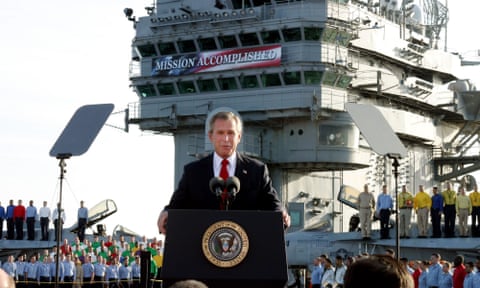
George W Bush in front of a navy warship

Iraq war: 20 years on

‘Tell me, how does this end?’ asked US general David Petraeus during first push to Baghdad in 2003

by  Diplomatic editor

The French statesman Georges Clemenceau once said: “War is a series of catastrophes that results in a victory.” In the case of the invasion of Iraq, however, the war that began 20 years ago started in victory and has ended in a series of catastrophes.

The main US military pullout from Iraq was ultimately completed by 2011, finally answering the question posed by Gen David Petraeus during that first push to Baghdad in 2003: “Tell me, how does this end?” Yet the long shadow of the invasion still looms over the international order, staining the reputation of those who instigated it and the political process itself, and dealing a heavy blow to the self-confidence that the west felt in the years after the fall of the Berlin Wall.

At this distance, on the eve of the twentieth anniversary on 20 March, it seems to matter less whether the war was launched on a deceit, a distortion, a wilful misapprehension, or a sincere false premise. It was a blunder that looks worse with every passing anniversary and memoir. Barack Obama drew one lesson from the episode: “Don’t do stupid shit.”

The question in the title of Baroness Ashton’s new book on diplomacy, And Then What?, was asked by many in relation to Iraq before the invasion. The risky consequences for Iraq were spelt out in memos and meetings at the time by Iraq experts in Britain such as Rosemary Hollis and Toby Dodge and by innumerable US Middle East specialists, including the current CIA chief, Bill Burns, but those who mattered, including the notably incurious George Bush, chose to ignore the warnings.

Dodge, freshly back from Iraq, was even invited to Downing Street to warn Blair that the invasion would be a disaster. He recalls Blair saying to him at the outset: “I know you think I should not do it, but I have to. I know it’s going to be bad. Tell me how bad it’s going to be”. Dodge explained: “In London and Washington, there was no one who had the first idea about Iraq, but they were planning to occupy it and run the place. It was hubris of the highest order.”

…MORE

Related
 

12 marzo, 2023
por Felipe Sahagún
Sin comentarios

The Deaths Putin Is Seeking to Keep Quiet (SPIEGEL INT)

 
Imagen

SPIEGEL

 
Russian volunteers are searching through graveyards, archives and the internet to determine how many of the country’s soldiers have actually died in Ukraine. A database they helped build provides some astonishing insights.
 

Not even 24 hours of the war had passed when the official account of the Russian district of Alagir reported that Aslan Mukhtarov had died. Acquaintances on social media commented on how Mukhtarov, 29, who died near the city of Kharkiv, was a «likeable, great guy.» The story appeared on a Russian news portal, as well. A few hours later, though, the district administration’s post had been deleted.

Around the same time, BBC journalist Olga Ivshina and a colleague began archiving news stories of a similar nature. She noted that there are no accurate figures available on Russian deaths in World War II, Afghanistan, Chechnya or Georgia. Ivshina and others didn’t want to see the same thing happen in Ukraine.

Journalists with the portal Mediazona, founded by two members of the Kremlin-critical punk band Pussy Riot, have also began collecting reports about Russian casualties in the early days of the war. A few weeks later, they decided to join forces with BBC journalist Ivshina and her colleagues. Since then, they have been operating the database together.

…MORE


12 marzo, 2023
por Felipe Sahagún
Sin comentarios

Seymour Hersh on the blasts at the Nord Stream Pipeline

Related

Ukraine denies involvement in Nord Stream pipeline blasts

Divers used chartered yacht to sabotage Nord Stream pipelines – report


12 marzo, 2023
por Felipe Sahagún
Sin comentarios

¿Y si no hubiera fronteras? (María Ramírez, eldiario.es)


La escritora y politóloga Lea Ypi contaba en un artículo hace unas semanas que durante unas vacaciones observó una tortuga que avanzaba justo entre la frontera de Albania y Grecia. Ella y sus hijos habían hecho cola para que les sellaran el pasaporte, un proceso burocrático molesto, pero inofensivo en comparación con la experiencia de su madre, que en 1997 se subió sobre la marcha a un barco para huir a Italia en medio de la guerra civil de su país, Albania. 

Continue leyendo →

12 marzo, 2023
por Felipe Sahagún
Sin comentarios

Next year in Moscow 3 (From Georgia to Ukraine)

In one sense, the war did not really begin in 2022. It did not even begin in Ukraine. It started the first time Vladimir Putin invaded one of Russia’s neighbours and got away with it. That was 15 years ago, in Georgia. And in the same place Joseph Stalin, author of the Soviet empire’s darkest chapter, was born.

New episodes released on Saturdays.

For full access to print, digital and audio editions, as well as exclusive live events, subscribe to The Economist at economist.com/moscowoffer

Next Year in Moscow 3

LINK