Relaciones Internacionales – Comunicación Internacional

26 mayo, 2022
por Felipe Sahagún
Sin comentarios

Uvalde’s killing (BBC, May 26, 2022)

Un policía deja un ramo de flores en la entrada de la escuela primaria Robb en Uvalde, Texas.

Otro tiroteo. Otra matanza en una escuela estadounidense.

Al menos 19 niños y dos maestras fueron asesinados este martes en la escuela primaria Robb en la localidad de Uvalde, Texas, un pueblo de 16.000 habitantes a unos 135 kilómetros de San Antonio.

El autor de la masacre, Salvador Ramos, tenía 18 años. Entró al centro educativo con una pistola y un rifle de asalto AR-15 y abrió fuego dentro de un salón de clases. Murió por disparos de la policía.

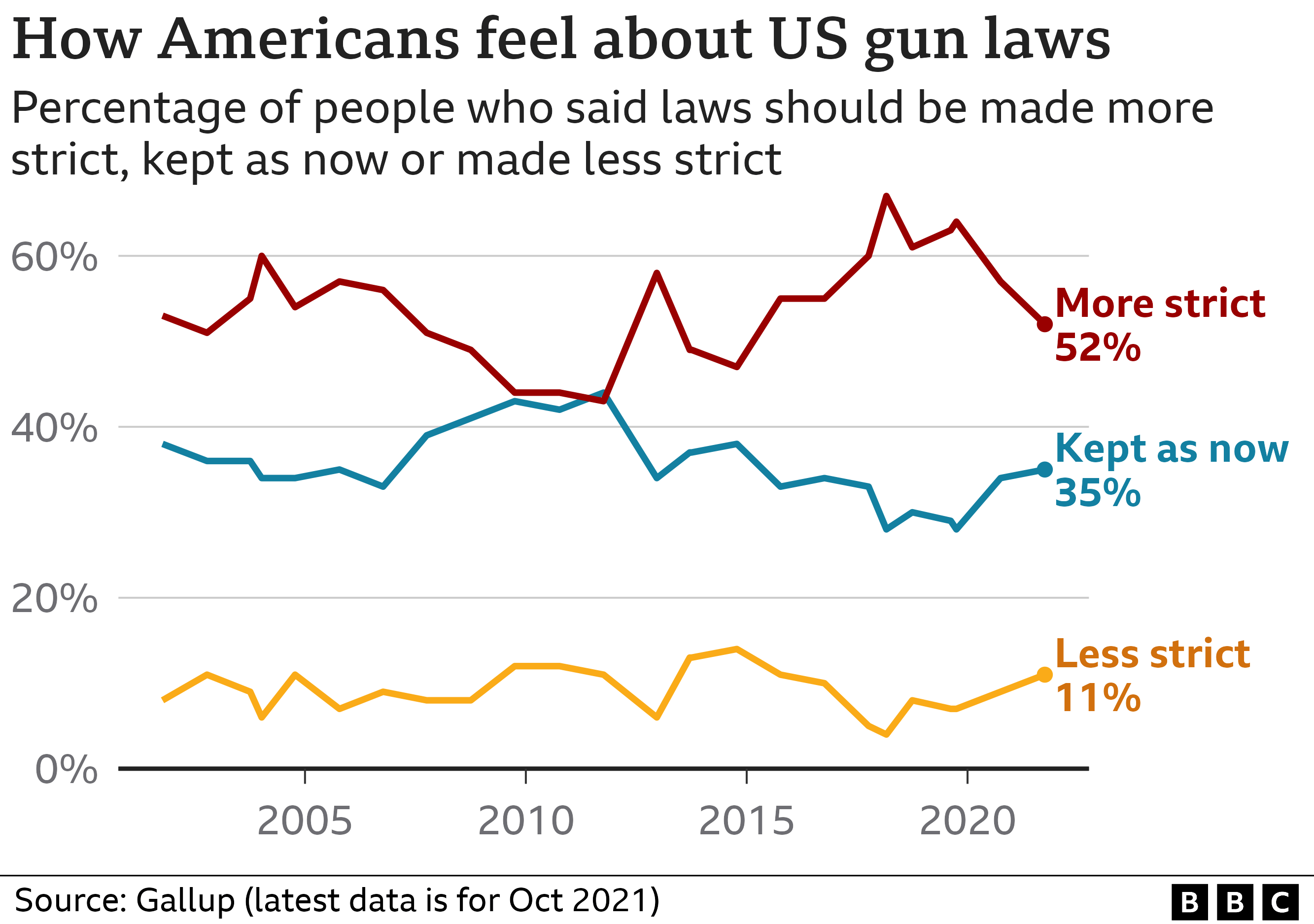
Este incidente reaviva el debate sobre la necesidad o no de controlar la posesión de armas de fuego.
…MORE


Chart showing attitudes to gun laws in the US

Texas shooting: Police urged to enter school during attack, witnesses say

By Robert Greenall & Angelica Casas & Chelsea Bailey
BBC News, London and Uvalde

Police were urged to charge into a deadly school shooting in Texas by onlookers, witnesses say, with one suggesting he considered doing so himself as he became frustrated.

Texas officials say gunman Salvador Ramos was inside the school in Uvalde for up to an hour before he was killed.

Nineteen children and two adults died, while 17 others were injured.

Eyewitness Juan Carranza told the Associated Press that women shouted at officers to «go in there».

But the 24-year-old, who witnessed the scene at the Robb Elementary School from outside his house, said police did not enter.

Javier Cazares, whose daughter was killed in the attack, told the news agency he suggested running in with other onlookers because the police «weren’t doing anything».

Authorities said the gunman locked himself in a classroom which officers then struggled to gain access to.

Steven McCraw, the director of the Texas Department of Public Safety, told a news conference on Wednesday that the gunman was on site for between 40 minutes and an hour before law enforcement were able to «contain» him.

US Border Patrol Chief Raul Ortiz, meanwhile, told CNN that dozens of officers responded to the shooting and «didn’t hesitate».

…MORE


23 mayo, 2022
por Felipe Sahagún
Sin comentarios

Putin will ‘be gone by 2023,’ predicts ex-MI6 chief (Newsweek)

Imagen

BY 

Sir Richard Dearlove, the former head of the British Secret Intelligence Service, predicted Thursday that Russian President Vladimir Putin will no longer be the leader of his country by 2023 due to health issues.

«I think he’ll be gone by 2023, but probably into the sanatorium,» Dearlove said during the One Decision podcast, adding that Putin, who is 69 years old, will not emerge as the «leader of Russia» anymore after coming out of the medical facility. «That’s a way to sort of move things on without a coup.» Continue leyendo →

23 mayo, 2022
por Felipe Sahagún
Sin comentarios

La cumbre de Madrid en plena guerra de Ucrania (INCIPE)

Javier Colomina, NATO Deputy Assistant Secretary General for Political Affairs & Security Policy and Special Representative for the Caucasus & Central Asia, participa en la quinta sesión del Ciclo #GrandesPotenciasOTAN. En un nuevo encuentro digital de INCIPE, titulado «Importancia de la Cumbre de Madrid en el contexto actual de seguridad».

23 de mayo de 2022


23 mayo, 2022
por Felipe Sahagún
Sin comentarios

The future of news (Reuters Institute)

Reuters Logo

Journalism is not a given in people’s lives. Here’s how to rethink the future of news

«We are in an era of extreme creativity. We need to match that in news,» writes BBC’s Ros Atkins in this piece adapted from a recent speech
May 17, 2022

I note my talk is called The Future of News – and that I have around 15 minutes to tell you what it is. I think at this point I should manage expectations. I’ve not got it all worked out. I definitely don’t know what the future is. But I have spent long enough trying to guess where we’re heading to have some rules of thumb – some guidelines that I hope give me at least a chance of working out how my journalism needs to evolve, and how organisations can evolve to give new types of journalism the best chance.   

This work of innovation and modernisation can sometimes feel like an extra. The form our journalism takes, the way we structure our staffing, the way we structure our daily output, developing products – this can feel secondary to the stories. And I get that: we all became journalists because of a desire to hold to account, to uncover stories – to tell stories. None of that has gone anywhere. But for me the moment we’ve reached is asking fundamental questions about where journalism fits into our world.

…MORE