Relaciones Internacionales – Comunicación Internacional

2 mayo, 2022
por Felipe Sahagún
Sin comentarios

Reconstrucción del 2 de mayo de 1808

¿Qué hubiera ocurrido si la radio hubiera sido testigo del levantamiento del pueblo de Madrid ante el ejército francés de Napoleón Bonaparte, el 2 de mayo de 1808? Éste era el punto de partida de otro de mis programas especiales, con los que pretendía demostrar la excelente salud de la radio como medio no sólo de comunicación, sino también de expresión. Corría el año 1996.

Así lo hubiera contado la radio en directo
  • Carmelo Encinas dirige un equipo de periodistas compuesto por Alfonso Ojea y Eduardo Martín, en las unidades móviles, junto con Miguel Ángel Oliver, Gema Rodríguez Lavín, Susana Moreno, Sonia Ballesteros y Eva Cuesta y las colaboraciones especiales de Elio Castro, Karmentxu Marín, Primitivo Rojas y los desaparecidos Gerardo González y Paco Barrero, todos ellos dirigidos por Gorka Zumeta

….MORE


2 mayo, 2022
por Felipe Sahagún
Sin comentarios

Foreign fighters, volunteers and mercenaries….

Imagen

New Special Report | «Foreign Fighters, Volunteers, and Mercenaries: Non-State Actors and Narratives in Ukraine» TSC is pleased to share a new report examining non-state actors in #Ukraine & the critical implications for states to consider. For more: thesoufancenter.org/research/forei:02 p. m. · 4 abr. 2022


1 mayo, 2022
por Felipe Sahagún
Sin comentarios

2022 White House correspondents’ dinner

After a two-year pandemic hiatus, the White House correspondents’ dinner returns on April 30 with comedian Trevor Noah headlining the event. President Biden will also attend, resuming the tradition for the first time since President Barack Obama. Biden’s predecessor, President Donald Trump, famously did not attend the dinner but was eviscerated by comedians Hasan Minhaj and Michelle Wolf. Read more: https://wapo.st/37PfKD8. Subscribe to The Washington Post on YouTube: https://wapo.st/2QOdcqK

29 abril, 2022
por Felipe Sahagún
Sin comentarios

Ciberseguridad en el sector público

https://youtu.be/OdFbhr4uT_Y

El Senado TV

La secretaria cuarta de la Mesa del Senado, Cristina Ayala, ha inaugurado la jornada “Ciberseguridad en el sector público”, acompañada del decano de la Facultad de Derecho, Empresa y Gobierno de la Universidad Francisco de Vitoria (UFV) y del CEO del Grupo CFI, Julio César de Miguel.

Al acto, organizado por la Universidad Francisco de Vitoria, han acudido otras autoridades como el director del Centro de Cciberliderazgo de la UFV, Robert Maxwell y el presidente del Centro para el Bien Común Global, Florentino Portero. Continue leyendo →

28 abril, 2022
por Felipe Sahagún
Sin comentarios

World military expenditure (SIPRI)

Imagen

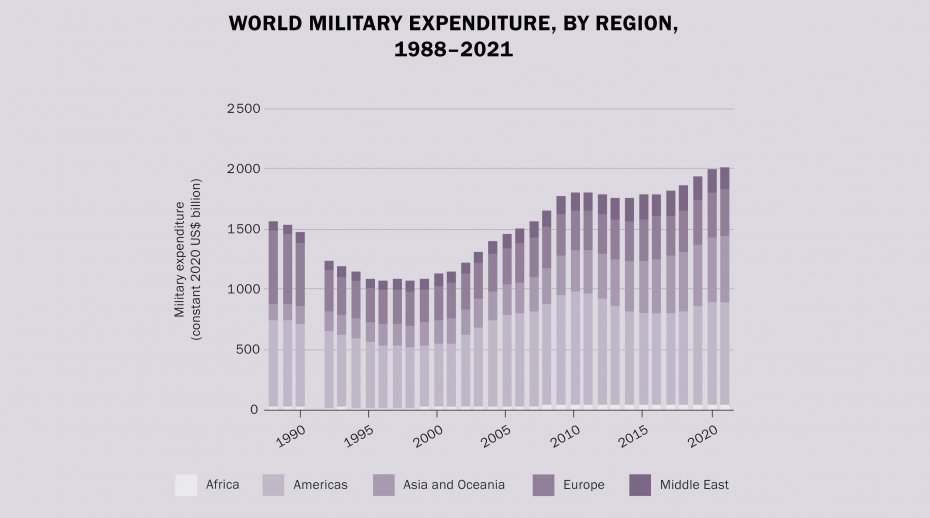
Stockholm, 25 April 2022) Total global military expenditure increased by 0.7 per cent in real terms in 2021, to reach $2113 billion. The five largest spenders in 2021 were the United States, China, India, the United Kingdom and Russia, together accounting for 62 per cent of expenditure, according to new data on global military spending published today by the Stockholm International Peace Research Institute (SIPRI).

Military expenditure reaches record level in the second year of the pandemic

World military spending continued to grow in 2021, reaching an all-time high of $2.1 trillion. This was the seventh consecutive year that spending increased.

‘Even amid the economic fallout of the Covid-19 pandemic, world military spending hit record levels,’ said Dr Diego Lopes da Silva, Senior Researcher with SIPRI’s Military Expenditure and Arms Production Programme. ‘There was a slowdown in the rate of real-terms growth due to inflation. In nominal terms, however, military spending grew by 6.1 per cent.’

As a result of a sharp economic recovery in 2021, the global military burden—world military expenditure as a share of world gross domestic product (GDP)—fell by 0.1 percentage points, from 2.3 per cent in 2020 to 2.2 per cent in 2021.

United States focuses on military research and development

US military spending amounted to $801 billion in 2021, a drop of 1.4 per cent from 2020. The US military burden decreased slightly from 3.7 per cent of GDP in 2020 to 3.5 per cent in 2021.

US funding for military research and development (R&D) rose by 24 per cent between 2012 and 2021, while arms procurement funding fell by 6.4 per cent over the same period. In 2021 spending on both decreased. However, the drop in R&D spending (–1.2 per cent) was smaller than that in arms procurement spending (–5.4 per cent).

‘The increase in R&D spending over the decade 2012–21 suggests that the United States is focusing more on next-generation technologies,’ said Alexandra Marksteiner, Researcher with SIPRI’s Military Expenditure and Arms Production Programme. ‘The US Government has repeatedly stressed the need to preserve the US military’s technological edge over strategic competitors.’

…MORE


28 abril, 2022
por Felipe Sahagún
Sin comentarios

World’s reliance on Russia for oil and gas (BBC)

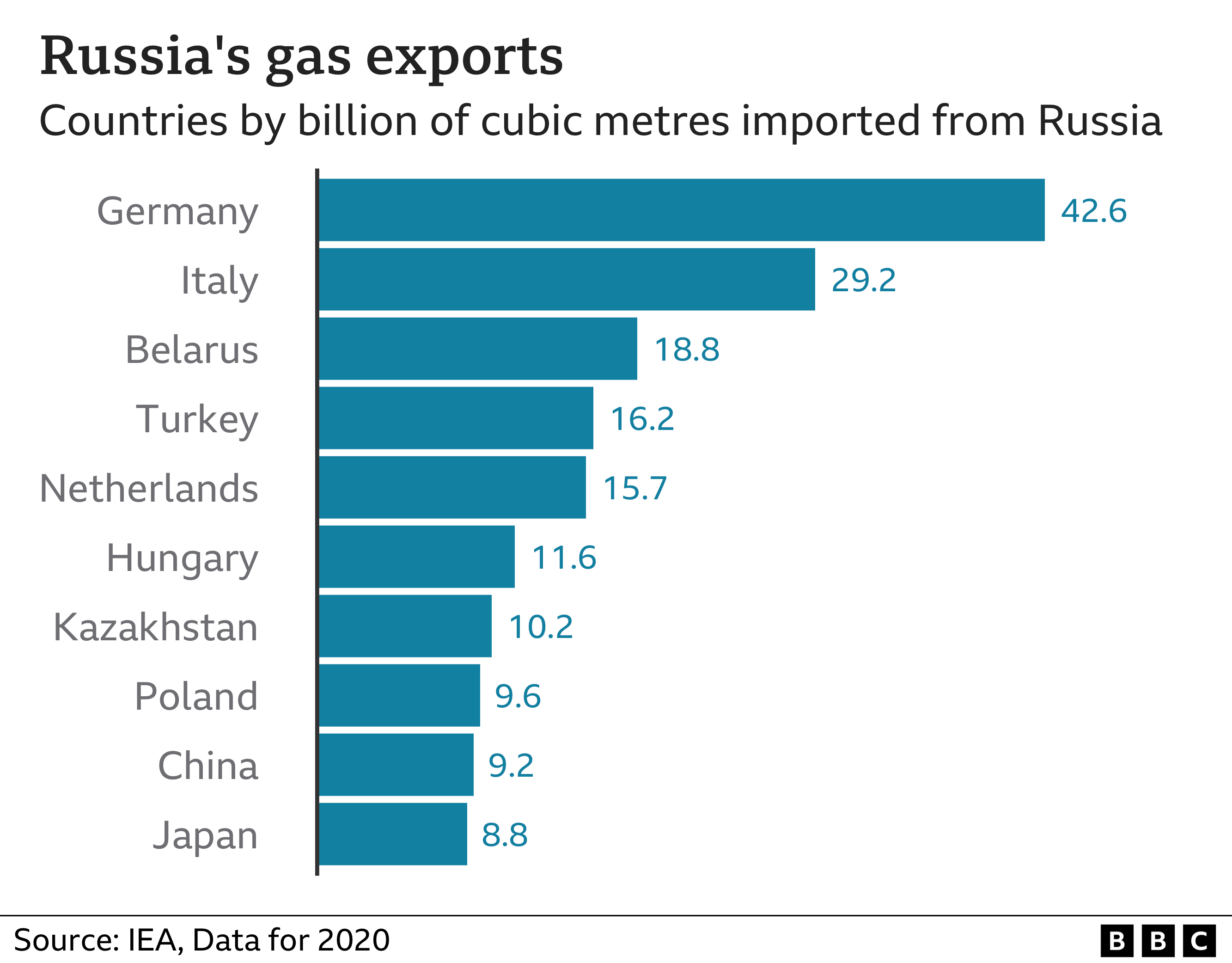
Russia gas exports

Russia says it’s no longer supplying gas to Poland and Bulgaria after the countries refused to pay for their supplies in roubles.

The EU has said it considers the move to be a form of blackmail.

What has happened?

Despite the invasion of Ukraine, Russia has continued to supply a large amount of gas to many European countries.

However, after Western powers placed financial sanctions on Russia, President Putin announced that «unfriendly» countries would have to pay for gas in Russian currency.

The Russian-state-owned energy company Gazprom has said it has cut off supplies to Poland and Bulgaria and will not restart these until payments are made in roubles.

EU Commission president Ursula von der Leyen has warned European energy providers against complying with Russian demands, saying that this would most likely be a breach of EU sanctions.

…MORE