Relaciones Internacionales – Comunicación Internacional

24 abril, 2022
por Felipe Sahagún
Sin comentarios

Ukraine and the disinformation war (Barack Obama)

Tomorrow, I’m heading to Stanford to deliver a speech about changes in the way we create and consume information, and the very real threat it poses to democracy. I’ve been reading up on this issue, sitting down with academics, researchers, industry leaders and former regulators, and listening to young leaders who are working to make progress.

Below is some of what I’ve read that offers useful context, solutions we can learn from, and interesting perspectives. Check it out, and then tune in to the speech on Thursday at 3:15pm ET / 12:15pm PT.

This report from the Aspen Institute offers an in-depth investigation into the chain reaction of harm caused by bad information.

Commission on Information Disorder Final Report via The Aspen Institute

A breakdown of how misinformation spreads and actionable steps platforms can take to stop it.

How to Stop Misinformation Before It Gets Shared via Wired

A look back at the events over the past ten years to help us understand how we got here.

Why the past 10 years of American Life Have Been Uniquely Stupid via The Atlantic

Here’s a good example about how social media companies can respond to disinformation when they want to.

Pinterest bans all climate change misinformation on its platform via Tech Crunch

The fight against disinformation can feel overwhelming, but there is reason for hope. This op-ed offers ideas on how we can become a more “disinformation resistant public.”

Fighting Disinformation Can Feel Like a Lost Cause. It Isn’t. via The New York Times

You may have come across this viral parallel-parking spot on your feed — this article breaks down how anonymous mobs can flourish online.

The Parallel-Parking Job That Ignited the Internet via Curbed

When people are exposed to different kinds of information, they can process it differently. This report by David Broockman and Joshua Kalla backs up what I’ve felt and seen and gives me faith that how we share information and argue about information can bring out our better angels.

The manifold effects of partisan media on viewers’ beliefs and attitudes: A field experiment with Fox News viewers

This self-appointed board is an encouraging example of what people across the country — and all over the world — are doing to try to figure out how to respond to the challenges we’re facing.

The Ad-Hoc Group of Activists and Academics Convening a “Real Facebook Oversight Board” via The New Yorker

This report from the Brennan Center offers an important look specifically at disinformation and voter suppression.

Digital Disinformation and Vote Suppression Report via Brennan Center

Here’s a story that shines a light on the intentional revenue models that are hurting local news and the consequences.

A Secretive Hedge Fund Is Gutting Newsrooms via The Atlantic

RELATED

Obama on disinformation (W Post editorial)
 

24 abril, 2022
por Felipe Sahagún
Sin comentarios

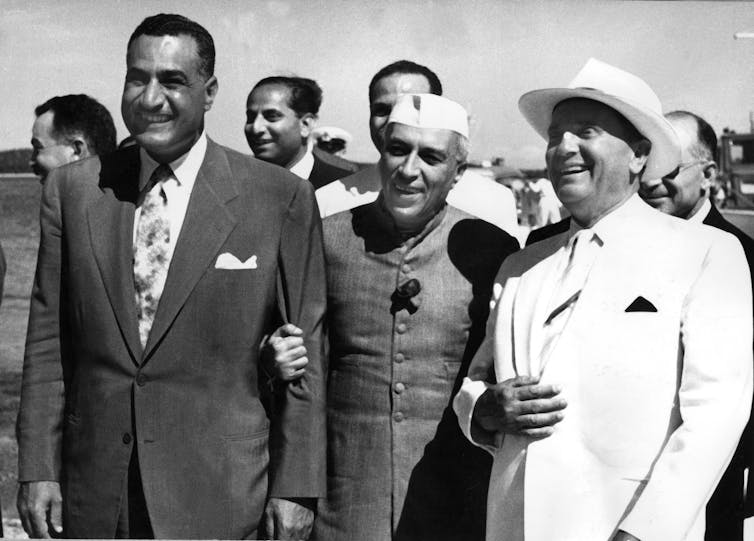
The Non-Aligned in Ukraine’s war are majority (The Conversation)

Yugoslav President Josip Broz Tito, Egyptian President Gamal Abdel Nasser and Indian Prime Minister Jawaharlal Nehru link arms in the sunshine.

Yugoslav President Josip Broz Tito, Egyptian President Gamal Abdel Nasser and Indian Prime Minister Jawaharlal Nehru attending a 1956 Non-Aligned Movement summit. AFP via Getty Images

By John Ciorciari

April 22, 2022

Russia’s invasion of Ukraine has brought strong Western condemnation and sanctions, but many nations around the world have chosen not to join this united front.

Dozens of governments outside Europe and North America have been reluctant to censure Russia, and many more have refrained from joining multilateral sanctions. China has tacitly supported the Kremlin since its February affirmation of a Sino-Russian friendship with “no limits.” A few others have backed Russia vocally, among them Belarus, which has served as a staging ground for the Russian invasion.

Meanwhile, other governments have sat on the fence. Brazilian President Jair Bolsonaro said pointedly that his country “will not take sides.” Indian leaders have reaffirmed their policy of nonalignment, implying that their nation will seek to stay out of the fight. South Africa, Pakistan and numerous other nations are following a similar path.

…MORE


24 abril, 2022
por Felipe Sahagún
Sin comentarios

Europa y el síndrome de Peter Pan (Josep Piqué, Pol. Exterior)

Política Exterior

Todos conocemos la historia de Peter Pan. Un preadolescente que se niega a crecer y opta por permanecer siempre en la fase de la inmadurez que caracteriza a la infancia. Dicho de otro modo, la negativa a asumir las responsabilidades propias inherentes al principio de realidad.

El proyecto político de Europa –la Unión Europea– sufre del llamado síndrome de Peter Pan. Queremos crecer, pero sin asumir las responsabilidades que eso implica. Queremos los beneficios, pero no los costes. Incluso queremos criticar a los padres, pero sin renunciar a su manto protector. Continue leyendo →

23 abril, 2022
por Felipe Sahagún
Sin comentarios

Gervasio Sánchez, testigo de guerra (TVE)

LINK to Video

Documental, reconocido con el Delfín de Oro al mejor Docudrama en los Cannes Corporate Media & TV Awardsse, que recoge un viaje a Sarajevo de la mano de Gervasio Sánchez para conocer a Adis Smajic, herido por una mina anti persona cuando tenía trece años.

Gervasio Sánchez lleva tres décadas recorriendo los países en conflicto acompañado de su cámara fotográfica documentando el dolor de las víctimas. Es un periodista que se ha mantenido independiente para poder denunciar en cualquier foro la implicación política y económica que los estados tienen en las guerras. A través de sus fotografías ha reflejado la fragilidad, indefensión y brutalidad a las que son expuestas las víctimas de cualquier conflicto bélico.
Su recorrido profesional arranca en 1984 y cubre la mayor parte de los conflictos armados, la guerra del golfo, Balcanes, África, Asia y América Latina. En su primer libro en 1994 “El cerco de Sarajevo” muestra la difícil vida de los civiles en la capital sitiada. En 1995 con su proyecto “Vidas minadas” documenta las vidas de víctimas de minas antipersona durante casi veinte años.

Related

‘Álbum de posguerra’, el rencuentro de Gervasio Sánchez con los niños que fotografió en Sarajevo, en cines

Gervasio Sánchez: “En Sarajevo la gente que quedó atrapada intentó mantener la dignidad ante el desastre y la inoperancia absoluta de la comunidad europea”


en octubre 28, 2021