
MOSCOW (AP) — With Russia carrying out a massive military buildup near Ukraine and the West roundly rejecting Moscow’s security demands, a window for diplomacy in the crisis appears to be closing. Continue leyendo →

11 febrero, 2022
por Felipe Sahagún
Sin comentarios
MOSCOW (AP) — With Russia carrying out a massive military buildup near Ukraine and the West roundly rejecting Moscow’s security demands, a window for diplomacy in the crisis appears to be closing. Continue leyendo →
11 febrero, 2022
por Felipe Sahagún
Sin comentarios
11 febrero, 2022
por Felipe Sahagún
Sin comentarios

Rewinding the clock? US-Russia relations in the Biden era -Études de L´IFRI nº 36. Feb 2022 (38 pages)
11 febrero, 2022
por Felipe Sahagún
Sin comentarios
Debate held on Thursday 25 November 2021.
Since 2014, Ukraine’s territorial integrity and security have been challenged by Russia’s annexation of Crimea and by the conflict in Donbas. Military maneuvers in spring and October 2021 have raised the threat of open armed conflict between Ukraine and Russia. Kyiv, on the other hand, continues to strengthen its defense capabilities. During this videoconference, the Ukrainian Minister of Foreign Affairs Dmytro Kuleba reflects on recent developments with regard to the Russian military buildup at Ukrainian borders and will be ready to answer your questions related to the broader foreign policy agenda of Ukraine. Moderation: Thomas Gomart, Director, Ifri.
Related
The West must face down Putin (by James Nixey, The World Today, Chatham House)
10 febrero, 2022
por Felipe Sahagún
Sin comentarios
Russia and Ukraine share a history dating back to medieval times, but since the dissolution of the Soviet Union in 1991 their relationship has been increasingly fraught. Putin has annexed Crimea and plunged Ukraine’s Donbas region into a drawn-out war. Some 75% of Ukrainians see their future in the European Union and 90% support independence. Why won’t Russia let its neighbour go?
The Economist, Feb 9, 2022
9 febrero, 2022
por Felipe Sahagún
Sin comentarios

Yemen is facing one of the world’s worst humanitarian crises as its brutal war enters its eighth year.
The UN estimates the war has killed 377,000 people as of the end of 2021, both directly and indirectly through hunger and disease – with 70 percent of those deaths being children.
Nearly half the country (14.5 million) of 30 million people does not have enough food, according to the World Food Programme.
Nearly half (47.5 percent) of children under five face chronic malnutrition.
At least 4 million people have been displaced by the seven years of war.
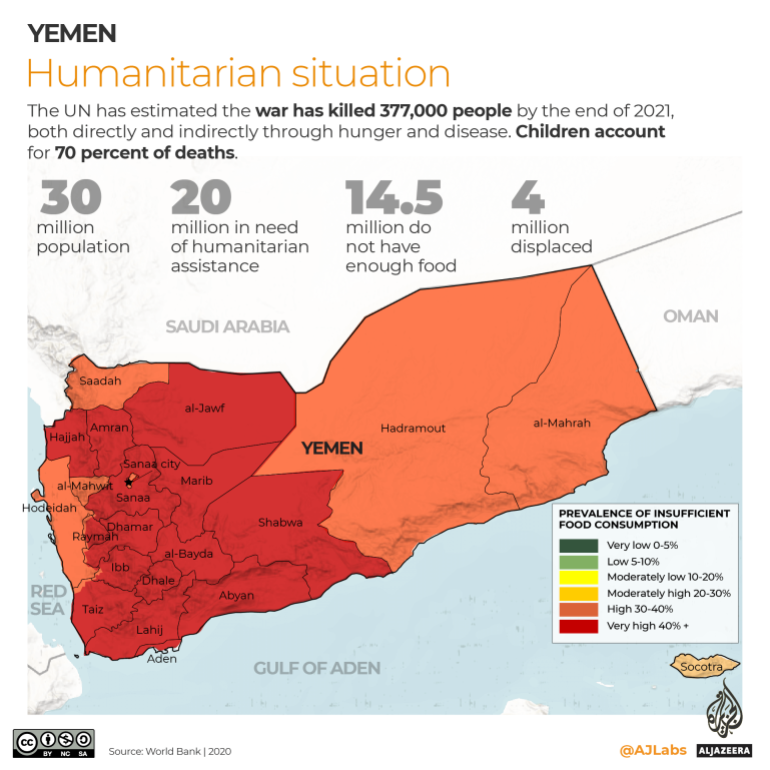
Key players in the conflict
In March 2015, a Saudi-led coalition – backed by the United States – intervened militarily in Yemen in a bid to fight the Iran-backed Houthi rebels, restore President Abd-Rabbu Mansour Hadi’s government, and reverse what they say is growing Iranian influence in the region.
