Relaciones Internacionales – Comunicación Internacional

21 septiembre, 2021
por Felipe Sahagún
Sin comentarios

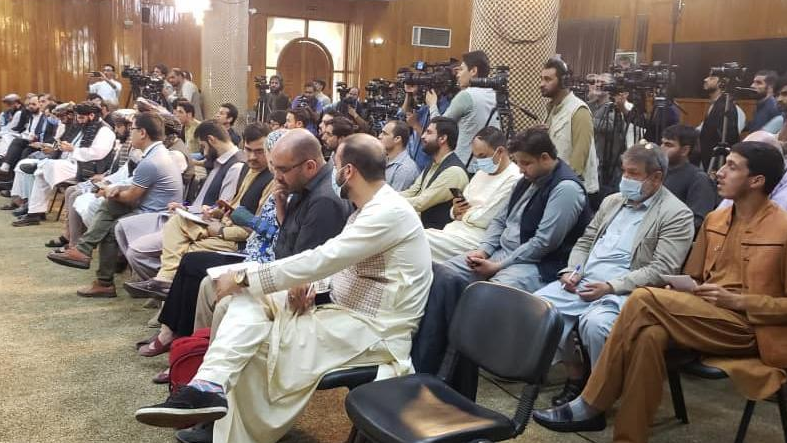
Taliban spokesperson briefs media on latest in Afghanistan (Sep 21, 2021)

https://news.cgtn.com/news/2021-09-21/Taliban-spokesperson-holds-press-conference-in-Kabul-13JFCNMlaM0/img/7a21afcaee144461a40a6a39ce0453f0/7a21afcaee144461a40a6a39ce0453f0.png

• Afghanistan’s acting foreign minister in a press conference on Tuesday called for international donors to restart aid and urged the international community not to politicize their assistance.

• The United Nations said Monday that it has obtained $1.1 billion in pledges from donors to help Afghanistan.

• On September 7, the Taliban announced the formation of Afghanistan’s caretaker government, with Mullah Hassan Akhund appointed as the acting prime minister.

• Taliban Supreme Leader Hibatullah Akhundzada said the newly formed acting government will start functioning soon.

Click here for our earlier report

LINK 


21 septiembre, 2021
por Felipe Sahagún
Sin comentarios

What AUUKUS means for Europe (ECFR)

Imagen

Dear Felipe,

American President Joe Biden last night announced a new pact with the UK and Australia to share advanced technologies, which many see as an effort to counter China’s power. The below ECFR experts comment on this announcement.

They are available for interview or comment.

  • The view from Beijing: «Beijing sees this as unnecessary provocation and is warning that the US approach cound backfire. The implications for non-proliferation and the strategic balance of power in the region is real.» by Janka Oertel
  • The allies: «Australia is feeling threatened by China’s growing assertiveness in the region. And it has every reason to do so. Beijing has demonstrated forcefully that it is willing to use coercive means to achieve its political goals. AUUKUS is a very concrete response of the US and its closest partners to this dynamic, but it carries the potential to further exacerbate tensions.» by Janka Oertel
  • The EU strategy: «If anything else, AUUKUS should be understood as a signal that EU member states risk marginalisation if they don’t get involved more seriously in Indo-Pacific affairs.» by Frederic Grare
  • The EU strategy: «Europeans so far have not been highly consistent in showing anything beyond rhetoric solidarity with countries challenged by Chinese coercion. This is about more than a deal on submarines. The real question is whether a US-led pushback on the security side against China in the Indo-Pacific region is in Europe’s strategic interest – or not. If it is, then AUUKUS might be a valuable component of this strategy and could be complemented by Europe’s Indo-Pacific push. If it is not, then Europe will have to come up with its own answers to credibly support regional partners – and do so quickly.» by Janka Oertel
  • The US view: «The agreement shows the strong determination of the Biden administration to confront China militarily in its own region and to do so in tight collaboration with regional allies. Relative to that goal, issues like nuclear non-proliferation and the sensitivities of France did not matter a great deal.» by Jeremy Shapiro
  • The French view: «»Coup de Trafalgar» is the expression on everyone’s lips in Paris right now. Though, the blow is directed at the French defence industrial level, the French government has already vehemently reacted against an announcement that shatters the current Indo-Pacific strategy. It would send a strong signal to have a declaration from Germany, the Netherlands and the EU on what the next steps in the region with major partners should be – with or without the Americans.» by Tara Varma

For further analysis from our experts:

For interviews or furhter comments, I can be reached at +49015165114216  and [email protected].  

Ana Ramic
Head of Communications
European Council on Foreign Relations (ECFR)
Unter den Linden 17, 10117 Berlin
M: +49 (0) 15165114216
E: [email protected] |@ana.ramic |

20 septiembre, 2021
por Felipe Sahagún
Sin comentarios

20 Years After 9/11 | Inside America with Ghida Fakry (TRTWORLD)

The world changed on September 11, 2001 after the attacks on the United States. In this one-hour special, Inside America looks back at what happened, how the US responded and the legacy of its so-called ‘war on terror’. Guests: Paul Bremer- Chairman of the National Commission on Terrorism (2010) Richard Ben-Veniste- Member of the 9/11 Commission Imraan Siddiqi- Executive Director of Council on American-Islamic Relations (CAIR) in Washington State Philip Alston- Former UN Special Rapporteur on Extrajudicial, Summary or Arbitrary Executions & Director of New York University School of Law’s Center for Human Rights and Global Justice Mansoor Adayfi- Former Guantanamo Bay Prison Detainee and author of “Don’t Forget Us Here” John Kiriakou- Former CIA officer who was the first US government official to confirm that the agency waterboarded detainees Watch other episodes of Inside America ➡ Weekly in-depth interviews with American opinion and policy-makers exploring the issues shaping US politics. 👉http://trt.world/InsideAmerica​Follow us: 👉www.twitter.com/_InsideAmerica 👉www.twitter.com/Ghida_Fakhry Subscribe: 👉Apple Podcasts: https://apple.co/3d0LYLy