Relaciones Internacionales – Comunicación Internacional

21 agosto, 2021
por Felipe Sahagún
Sin comentarios

The Fall of Afghanistan: What Next? (FT)

Dear Felipe, 

We are delighted to confirm that your registration for The Fall of Afghanistan: What Next? has been successful.

You will also shortly receive a confirmation email with your basic registration information.

Ahead of the event, we encourage you to familiarize yourself with the agenda and speakers to make the best of your participation at this webinar. 

You can find all of the event information here: afghanistan.live.ft.com

We look forward to welcoming you to the event.

Best wishes, 

Financial Times Live team

21 agosto, 2021
por Felipe Sahagún
Sin comentarios

Los talibán y cómo recuperaron el control de Afganistán (BBC)

BBC News Mundo (16 agosto 2021)

Las escenas de caos y desesperación se multiplican en Kabul, capital de Afganistán, luego de que el Talibán tomara el control del país tras 20 años de insurgencia y en medio del fin de la retirada de las tropas de Estados Unidos de su territorio.

Tras una operación militar relámpago, el grupo islamista avanzó hasta hacer colapsar al gobierno afgano y ahora asegura que habrá una transferencia pacífica del poder.

¿Pero quiénes son los talibanes y cómo lograron retomar el control del país en unas pocas semanas? Te lo explicamos en este video.

Related

Requiem por Afganistán (Carlos Miranda)

Biden’s Afghanistan fiasco (Edward Luce, FT)

CIA’s Former Counterterrorism Chief for the Region: Afghanistan, Not An Intelligence Failure — Something Much Worse


20 agosto, 2021
por Felipe Sahagún
Sin comentarios

Afghanistan: Watching It All Fall Apart (NYTimes)

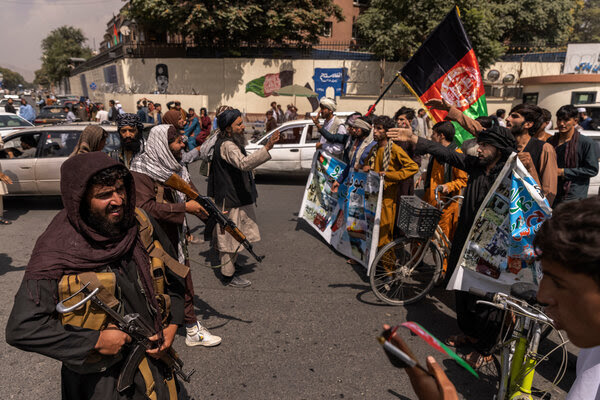
Taliban gunmen confronting pro-government protesters as they rallied in commemoration of Afghan Independence Day in Kabul, Afghanistan, on Thursday.Victor J. Blue for The New York Times

Letter from Douglas Schorzman to NYT readers

August 20, 2021

Dear reader,

Yeah, us, too. We’ve been watching Afghanistan with a sick feeling in our guts, with worry in our hearts about colleagues and friends, and with spinning heads as we try to assess the failures of vision and execution that allowed a 20-year development effort to utterly collapse over just nine days.

I started as an editor at The New York Times in 2001. And after Sept. 11, like a lot of you, my focus suddenly shifted overseas — I joined the International Desk as the first U.S. airstrikes hit Afghanistan, and the war’s turns have largely defined my career. So the headlines we’ve been writing this week feel completely surreal:

It’s hard to sort through those two decades — and all the war’s cost in lives, and living — without anger. Was all that talk about opportunity for a new generation of Afghans just false hope, or simply a lie? Is the world really safer from terrorism?

Was it really all for nothing?

I keep thinking back to a young media manager we talked to in Kabul in 2018. He’s the embodiment of what the West liked to talk about in Afghanistan: a young and worldly intellectual, an ethnic Hazara who took every advantage of the educational and business opportunities that opened up after the Taliban fell.

But times were getting alarming. It was clear the Americans wanted out. Talks were about to open between the Taliban and U.S. envoys, but it seemed the Taliban held all the cards. The Afghan government seemed just a single crisis away from falling.

A colleague asked this young Afghan what he thought would happen if the Americans just walked away. He gave a kind of half-smile and said, without hesitation, “Darkness.”

“Look,” he said, “it’s not a question of whether violence and backslide will happen — it’s when.”

It’s the when that I’m struggling with right now. The Americans left Afghanistan before they were gone, and the Taliban knew it.

The group’s senior leadership is doing victory laps in Kandahar and Kabul, discussing the terms of their control with Afghan leaders who have no leverage left at all, while American officials are trying to rush an evacuation.

For the first time, we all saw the face of the Taliban’s speed-dial spokesman, Zabihullah Mujahid, telling us on camera that the Taliban were ready to enter the global mainstream. He talked about rights for women. About how the war was finally over now, and everyone wanted peace.

But the veneer was already slipping before they could paint it. For weeks, American veterans’ phones have been blowing up with panicked calls from Afghan interpreters and soldiers whom the Taliban were threatening wouldn’t survive the month. The reports of vengeance killings are coming in more often now, even as the Taliban promise amnesty.

Maybe someday it will start to make sense. But the task now is to keep a spotlight on Afghanistan, and to try to keep the world from looking away.

— Doug

Douglas Schorzman is a deputy international editor for The New York Times.

20 agosto, 2021
por Felipe Sahagún
Sin comentarios

A billion children at ‘extreme risk’ from climate impacts – Unicef

Imagen
 Environment editor

Almost half the world’s 2.2 billion children are already at “extremely high risk” from the impacts of the climate crisis and pollution, according to a report from Unicef. The UN agency’s head called the situation “unimaginably dire”.

Nearly every child around the world was at risk from at least one of these impacts today, including heatwaves, floods, cyclones, disease, drought, and air pollution, the report said. But 1 billion children live in 33 countries facing three or four impacts simultaneously. The countries include India, Nigeria and the Philippines, and much of sub-Saharan Africa.

The report is the first to combine high-resolution maps of climate and environmental impacts with maps of child vulnerability, such as poverty and access to clean water, healthcare and education. “It essentially [shows] the likelihood of a child’s ability to survive climate change,” said Nick Rees, one of the report’s authors.

…MORE


20 agosto, 2021
por Felipe Sahagún
Sin comentarios

Inside Clarissa Ward’s 19-Hour Days Reporting From Kabul (Esquire)


When CNN’s Clarissa Ward approached a Taliban fighter on the streets of Kabul on Wednesday, a gunshot rang out behind her. If you saw this on Anderson Cooper’s nightly show, you might have missed her flinch. It was brief. Subtle. Her focus remained squarely on the group of Taliban fighters in front of her, including a man who shoved his hand forward to cover her cameraman’s lens and waved a whip made of heavy chain and a padlock. The chaotic scene, he told her, is America’s fault.

As he spoke, Ward noticed his eyes. They look dazed, she told me. Was he high, whether from a narcotic or pure adrenaline? She wondered.

Suddenly, he said he didn’t want to talk to her, and she calmly walked away. Another man walked up to ask Ward for advice on how to get out. As she tried to answer him, more gunshots. These were louder. This time her flinch was more visible. But her voice was level as more men in the crowd came up to show her their documents, explaining they’ve worked as translators and are desperate for help to leave the country. The Taliban fighter with whom she first spoke, the one with the makeshift whip, pushed past them, releasing the safety of his AK-47, threatening to shoot into the crowd.

…MORE

Related