

Trump’s 20 promises: all lies or smoke
Related
Fact-checking Trump’s lies is essential. It’s also increasingly fruitless (W Post)

29 agosto, 2020
por Felipe Sahagún
Sin comentarios
Trump’s 20 promises: all lies or smoke
Related
Fact-checking Trump’s lies is essential. It’s also increasingly fruitless (W Post)
29 agosto, 2020
por Felipe Sahagún
Sin comentarios
 Política, economía e ideas sobre el mundo en español
28 agosto, 2020
por Felipe Sahagún
Sin comentarios

Its economic growth is likely to slow dramatically as its population ages and labor force shrinks
People are justifiably worried about China. It is wrecking Hong Kong and has lost international trust in the process, which makes it difficult to form future deals with its leadership. China’s divide-and-conquer diplomacy abroad, particularly toward countries smaller than the U.S., is aggressive and immature. Xi Jinping’s statist economic strategy has returned to the Maoist model, putting private enterprise under the thumb of the Communist Party at home and exploiting foreign trade relationships.
I support efforts to call out such outrageous behavior—and to work with partners and allies, who largely agree with us about this—to develop the most effective approach possible to deal with it.
Americans long underestimated China’s progress and its leaders’ ambitions. I reluctantly accept that today’s China is different from the one I once worked with constructively. But as we deal with the present, we should also consider future relations with a country that faces significant emerging internal structural problems. China’s next 20 years are unlikely to repeat its past 20.
Take the labor force. Growth in gross domestic product is a factor of a country’s labor-force and productivity growth. Deng Xiaoping once told me how the ingenuity and hard work of the Chinese people would power huge advances, given market liberalizations. That combined with an explosion in the pool of available workers—a youthful population bulge, plus migration from farms to cities. China’s GDP grew from 11% of the U.S.’s in 1997 to 63% two decades later, in the process lifting hundreds of millions out of abject poverty. But the labor force of Mr. Xi’s China is now declining—in contrast to the steady, immigration-driven growth of the U.S.—and is projected to lose 174 million workers by midcentury. To borrow a phrase from the political economist Nicholas Eberstadt, this will “bound the realm of the possible” in the Chinese economy.
27 agosto, 2020
por Felipe Sahagún
Sin comentarios
 START and SIA present a virtual symposium on changing threats
The Security Industry Association, START and the University of Maryland will host a virtual event Thursday, Sept. 10 at 1 p.m. that teaches how new tools and partnerships can mitigate changing threats. Topics will include the capability development framework tool for risk assessment, horizon scanning for future threats and the new generation of threats and countermeasures. The day will conclude with Q&A. The event is free and open to the public.
Report on Global Terrorism 2019
27 agosto, 2020
por Felipe Sahagún
Sin comentarios
ICYMI: START releases Global Terrorism Overview
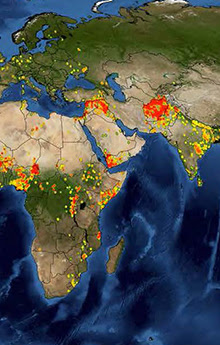
The new START Global Terrorism Overview details the nearly 8,500 terrorist attacks that resulted in 20,300 deaths around the world in 2019. Terrorist violence around the world dropped for the fifth straight year, heavily driven by declining attacks in Iraq, however a pair of exceptionally lethal mass killings in the United States and New Zealand led to an increase in deaths from racially and ethnically motivated terrorism.
27 agosto, 2020
por Felipe Sahagún
Sin comentarios
 Issue 4/2020
