Relaciones Internacionales – Comunicación Internacional

25 marzo, 2020
por Felipe Sahagún
Sin comentarios

How journalists can help stop the pandemic (Reuters Inst)

Reuters Institute@risj_oxford
NEW on our website
What will the coronavirus pandemic mean for the business of news? «A lot of news media won’t make it but this is an opportunity for some,» writes our Director
 
What will the coronavirus pandemic mean for the business of news?
«A lot of news media won’t make it but this is an opportunity for some,» writes our Director Rasmus Nielsen  reutersinstitute.politics.ox.ac.uk


25 marzo, 2020
por Felipe Sahagún
Sin comentarios

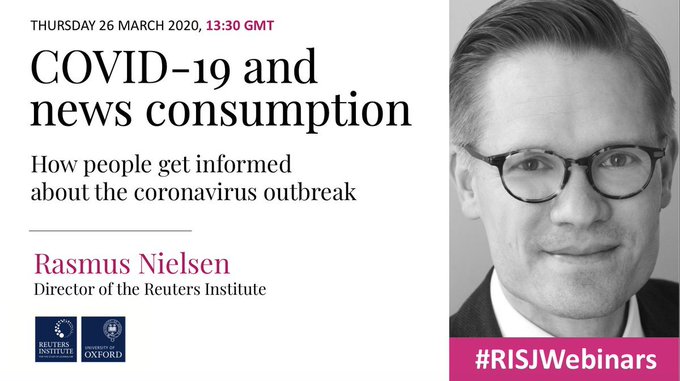
How do people around the world get informed about the pandemic? (Reuters Institute)

Imagen
 
Reuters Institute @risj_oxford

Our Director @rasmus_kleis will lead a webinar on #COVIDー19 and news consumption. Thursday 26 March

13:30 GMT / 14:30 CET / 8:30 ET / 18:00 Delhi Time

Sign up in this link reutersinstitute.politics.ox.ac.uk/calendar/how-d

24 marzo, 2020
por Felipe Sahagún
Sin comentarios

COVID19 and the story of China (Lowy Institutde)

The Lowy Institute✔@LowyInstitute

Listen now on SoundCloud: http://bit.ly/2IWDZz0 

Related

Disinformation and coronavirus

COVID19 and migration

Pandemic peace or anarchical world?

A speech for the age of the self-isolated

The future ain’t what it used to be


24 marzo, 2020
por Felipe Sahagún
Sin comentarios

COVID-19 and Conflict: Seven Trends to Watch (Crisis Group)


Robert Malley@Rob_Malley
1/ Today, we publish 1st in series of @crisisgroup briefings on potential impact of #COVID-19 on conflicts & crises worldwide. This one examines 7 trends to watch in terms of the pandemic’s direct and indirect political consequences

COVID-19 and Conflict: Seven Trends to Watch

crisisgroup.org

The COVID-19 pandemic unquestionably presents an era-defining challenge to public health and the global economy. Its political consequences, both short- and long-term, are less well understood.

The global outbreak has the potential to wreak havoc in fragile states, trigger widespread unrest and severely test international crisis management systems. Its implications are especially serious for those caught in the midst of conflict if, as seems likely, the disease disrupts humanitarian aid flows, limits peace operations and postpones or distracts conflict parties from nascent as well as ongoing efforts at diplomacy. Unscrupulous leaders may exploit the pandemic to advance their objectives in ways that exacerbate domestic or international crises – cracking down on dissent at home or escalating conflicts with rival states – on the assumption that they will get away with it while the world is otherwise occupied. COVID-19 has fuelled geopolitical friction, with the U.S. blaming China for the disease while Beijing tries to win friends by offering aid to affected countries, exacerbating existing great-power tensions that complicate cooperation on crisis management.

It is not yet clear when and where the virus will hit hardest, and how economic, social and political factors may converge to spark or aggravate crises. Nor is it guaranteed that the pandemic’s consequences will be entirely or uniformly negative for peace and security. Natural disasters have sometimes resulted in the diminution of conflicts, as rival parties have had to work together, or at least maintain calm, to focus on preserving and rebuilding their societies. There have been a few signs of governments trying to ease political tensions in the shadow of COVID-19 with, for example, the United Arab Emirates (UAE) and Kuwait offering Iran – centre of one of the worst initial outbreaks outside China – humanitarian assistance. If the pandemic is likely to worsen some crises internationally, it may also create windows to improve others.

…MORE


24 marzo, 2020
por Felipe Sahagún
Sin comentarios

Poynter drops tuition through May 31st, 2020

WTD Header

As a public service to the journalism education community during the coronavirus pandemic, we are pleased to announce that we dropped tuition for all News University webinars and self-directed courses through May 31, 2020.

Below are a few of NewsU’s most popular classes, now available for free for educators with code 20COLLEGE100:

Poynter Primers — great for your introductory courses
Consider adopting all three primers in the set or pick those that best fit your needs.

More advanced courses
From news editing to public relations, News University is ready with upper-division course resources. 

A full list of applicable courses can be found under Resources for Educators and Students under «Journalism Fundamentals.» 
FACT-CHECKING THE CORONAVIRUS
Poynter is the fact-checking capital of the world, home to three fact-checking entities: the International Fact-Checking Network, PolitiFact and MediaWise. We are uniquely equipped to lead the fight against the global coronavirus infodemic. 

Here’s how you can join us and stay on top of coronavirus misinformation:

How will coronavirus-related closures and quarantines affect crime rates? By Al Tompkins.

The role of the press in the coronavirus pandemic is to provide truth, even if that truth is grim. By Tom Jones.

As higher education continues to pivot into a virtual reality, here are some resources for professionals and students charged with teaching or covering campuses remotely. By Barbara Allen.

Younger demographics have a higher coronavirus risk than commonly believed. Here’s how to talk to that audience. By Al Tompkins.

12 writing tools to make COVID-19 coverage comprehensible. By Roy Peter Clark.