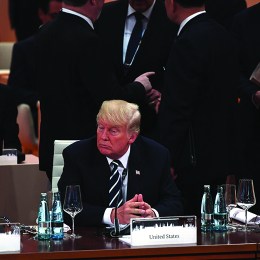
Trump mal visto en todo el mundo, pero EEUU tiene una imagen favorable, según informe de PEW
Washington, 8 Ene 2020 (AFP) – El presidente Donald Trump es mal visto por la opinión pública mundial, debido sobre todo a su política aislacionista, pero Estados Unidos mantiene una buena imagen internacional, según un informe del centro de investigación estadounidense Pew, publicado el miércoles.
Menos de un tercio (29%) de los encuestados cree que el multimillonario republicano toma «las decisiones correctas», mientras que el 64% piensa lo contrario, dice el Centro de Investigación Pew, que ha recopilado las opiniones de más de 35.000 personas en más de 30 países de los cinco continentes entre mayo y octubre de 2019. Continue leyendo →
Miradas al exterior – Periodismo exterior – 05/01/20. Miradas al exterior online, completo y gratis en A la Carta. Todos los informativos online de Miradas al exterior en RTVE.es A la Carta rtve.es
FMR Asst Sec Defense, Chair NATO’s HLG, CIA Clandestine Service, Successful Entrepreneur, Republican for strong national defense, lawyer, PSU grad.
Let’s have some straight talk on #Soleimani, shall we?
1. Suleimani took command of the Quds Force over 20 years ago and his job is to reshape the Middle East in Iran’s favor: thru military force, by assassinating rivals and arming allies.
2. His twenty year focus is directing a network of militant groups that has killed hundreds of U.S in #Iraq and others.
3. I know of only ONE American who has ever met him, John Maguire, describing him as soft-spoken yet the most powerful man in the MidEast. Thoughtful, strategic, smart, charismatic – 100% dedicated
4. He personally runs #Iran’s war in #Syria and brought in thousands of #Quds Force when #Assad’s army began to fail.
5. Suleimani and #Nasrallah of #Hezbollah#Lebanon are old friends and cooperate globally where Hezbollah has performed terrorist acts at Iran’s behest.
6. His power comes from his impeccable revolutionary credentials and his close relationship with #Khamenei, The Supreme Leader, who has referred to Suleimani as “a living martyr of the revolution.” Suleimani is a hard-line supporter of Iran’s authoritarian system but is rich and has built the #IRGC into an economic powerhouse.
7. He hates #Israel and Jews and is well known to its intelligence services as a superbly effective operative; in some ways, he is both hated and admired
8. #Suleimani has orchestrated terrorist attacks in places as far flung as #Thailand, #New Delhi, #Argentina, #Lagos, and #Nairobi— at least fifty attempts in the past 20 years. The most notorious was in 2011 against #KSA Ambass #AdelalJubeir when #Iran hired a drug cartel to blow him up at in D.C. Suleimani’s agent turned out to be a #DEA informant .
9-#Suleimani was pragmatic. He worked indirectly with #RyanCrocker of State Dept in helping the U.S target the #Taliban and in selecting Shia officials for the new #Iraqi Gov’t.
10. That cooperation was short lived, however. In 2004, the Quds Force began flooding Iraq with“explosively formed projectiles “ that accounted for nearly twenty per cent of U.S Iraq combat deaths. Roadside E.F.P.s were made by skilled technicians in Iran and were supplied by #QodsForce. They also resulted in tens of thousands of maimed U.S and Iraqi soldiers.
11. In recent years, the #IRGC has posted social media videos of #Soleimani directing attacks in #Mosul and against #IraqiKurd forces. He has traveled widely and has unprecedented autonomy in carrying out his military-terrorist mandate.
12. Those who refer to his death as “political assassination” of a “foreign official” are either grossly ill-informed or willfully blind. In my experience, his involvement in targeting U.S military personnel alone has made him a legitimate target of at least TWO U.S Presidents, although@realDonaldTrump is the first to have succeeded. On at least two occasions in which I am aware, previous operations in other administrations were canceled due to intel or other complicating factors.
13. Given the prominence of #Soleimani in all of #Iran’s extra-territorial operations, both military and civilians have considered the implications of directing operations aganist him on multiple occasions, including 2nd and 3rd order impacts/retaliation from various adversaries.
14. I hope this is useful. There is an excellent profile of #Soleimani from Dexter Filkins@NewYorker from 2013 that gave a good feel for #Soleimani using excellent sources.
I know everyone is having fun being outraged, but there would not be «cultural» targets on any US target list. Such sites are on a «no-strike list» and/or a «restricted target list» including all UNESCO sites and many others, incl mosques, schools, etc.
Qasem Soleimani, commander of the Islamic Revolutionary Guard Corps Quds Force, was one of the most influential and popular figures in the Islamic Republic and a particular nemesis of the United States. He led Iran’s campaign to arm and train Shiite militias in Iraq—militias responsible for the deaths of an estimated 600 American troops from 2003 to 2011— and became the chief purveyor of Iranian political influence in Iraq thereafter, most notably through his efforts to fight the Islamic State (ISIS). He drove Iran’s policies to arm and support Syrian President Bashar al-Assad, including by deploying an estimated 50,000 Shiite militia fighters to Syria. He was the point man for Iran’s relationship with Hezbollah in Lebanon, helping to supply the group with missiles and rockets to threaten Israel. He drove Iran’s strategy to arm the Houthis in Yemen. For all these reasons and more, Soleimani was a cult hero in Iran and across the region.
In short, the United States has taken a highly escalatory step in assassinating one of the most important and powerful men in the Middle East.
The administration of U.S. President Donald Trump argues that Soleimani was a terrorist and that assassinating him was a defensive action that stopped an imminent attack. Both of those assertions may or may not be true, but the United States would never have felt compelled to act against the Iranian general if not for the reckless policy the administration has pursued since it came into office. In May 2018, Trump left the Iran nuclear agreement and adopted a “maximum pressure” policy of economic sanctions on Iran. For a year, Iran responded with restraint in an effort to isolate the United States diplomatically and win economic concessions from other parties to the nuclear agreement.
But the restrained approach failed to yield material benefits. By May 2019, Tehran had chosen instead to breach the agreement and escalate tensions across the region. First came Iranian mine attacks against international shipping in May and June. Then Iran shot down a U.S. drone, nearly touching off an open conflict with the United States. In September, Iranian missiles struck the Abqaiq facility in Saudi Arabia—arguably the most important piece of oil infrastructure in the world. Shiite militia groups began launching rockets at U.S. bases in Iraq, ultimately leading to the death of an American contractor last week. Retaliatory U.S. strikes eventually brought us to the Soleimani assassination.
The EU has in place, or is negotiating, trade agreements with countries and regions around the world. eu.smh.re
Mirzha de Manuel@mirzhadmaThe EU has in place the largest trade network in the world, with 41 trade agreements covering 72 countries. More on the state of #EUtrade → https://eu.smh.re/6X8