Relaciones Internacionales – Comunicación Internacional

6 abril, 2019
por Felipe Sahagún
Sin comentarios

Periodistas, correveidiles y zotes (@RamonLobo)

infolibre Periodismo libre e independiente

Publicada el 04/04/2019 a las 06:00

“Soplan malos vientos para la libertad de prensa en el mundo, porque soplan malos vientos para la libertad”, escribe Alfonso Armada, director de FronteraD, una joya digital que cumplirá 10 años en noviembre. El texto se titula Enemigos del pueblo. Armada también es presidente de Reporteros Sin Fronteras (RSF) en España, poeta, autor teatral, viajero y sabio. En su artículo recuerda que la revista estadounidense Time eligió Persona del Año a “los guardianes de la libertad de expresión”. Ser periodista no está tan mal visto en otros lares. Antes habría que definir el oficio, para saber quiénes están dentro y quiénes fuera. Continue leyendo →

6 abril, 2019
por Felipe Sahagún
Sin comentarios

Russian disinformation

In January 2017, the U.S. intelligence community released a public report detailing a Russian influence campaign, ordered by Russian President Vladimir Putin, to disrupt the U.S. presidential election. Part of a larger multifaceted approach, this campaign included social media–based disinformation spread by both automated bots and paid trolls. Russia’s strategy was to push several conflicting narratives simultaneously, deepening existing divisions within American society and degrading trust in Western institutions and the democratic process.

While it is unknown what impact the campaign might have had on the 2016 presidential election, or on individual opinions, it is clear that Russia’s efforts reached many Americans through a variety of social media platforms, including Twitter and Facebook. The Russian «disinformation chain» that directs these campaigns starts from the very top — from Russian leadership, to Russian organs and proxies, through amplification channels such as social media platforms, and finally to U.S. media consumers. This report categorizes and analyzes different approaches and policy options to respond to the specific threat of Russian influence via disinformation spread on social media in the United States. It is meant to educate and inform U.S. government officials considering policies for combating Russian disinformation; social media companies undertaking efforts to reduce the spread of disinformation on their platforms; NGOs, think tanks, and academics developing new approaches to address the threat of disinformation; and the American public.

Continue leyendo →

4 abril, 2019
por Felipe Sahagún
Sin comentarios

South China Sea’s Dark Fishing Fleets (The Washington Post)

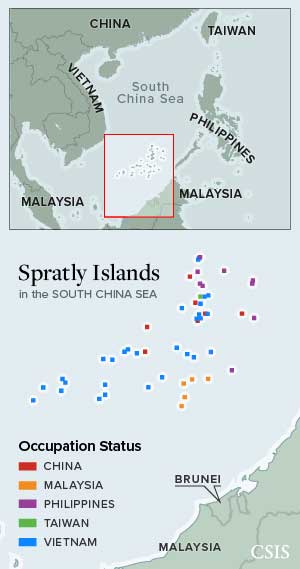
Unseen fishing activity. Maritime militias in the Spratlys. Fishers have often been overlooked in the South China Sea disputes. CSIS, in cooperation with Vulcan, Inc., unveils a worrying narrative about the impact fishers and their fleets have in the region.

The South China Sea has emerged as one of the most dangerous flashpoints in the Indo-Pacific over the last decade. With China’s expansion and militarization of its holdings in the disputed Spratly Islands from late 2013, tensions have escalated rapidly.

The South China Sea is home to two sets of disputes.

One is over sovereignty. China, Taiwan, Brunei, Malaysia, the Philippines, and Vietnam claim various islands, rocks, and reefs around the sea.

The other involves those parties and Indonesia. The dispute is over how to divide the sea itself.

Southeast Asian claimants assert rights to overlapping maritime zones under international law.

China and Taiwan, however, claim ill-defined rights over a vast area bordered by the so-called Nine-Dash Line.

The security implications of these disputes receive significant attention, and the disputants’ navies, air forces, and coast guards are studied closely to assess the balance of power and risk of escalation. But too little attention has focused on another key set of actors in the South China Sea—the fishers who serve on the frontlines of this contest. Those fishers face a dire threat to their livelihoods and food security as the South China Sea fisheries teeter on the brink of collapse.

more than  50% of the fishing vessels in the world are estimated to operate in the South China Sea.

The South China Sea accounted for 12 percent of global fish catch in 2015, and more than half of the fishing vessels in the world are estimated to operate there. Its fisheries officially employ around 3.7 million people and unofficially many more. But the South China Sea has been dangerously overfished. Total stocks have been depleted by 70-95 percent since the 1950s, and catch rates have declined by 66-75 percent over the last 20 years. Continue leyendo →