Relaciones Internacionales – Comunicación Internacional

1 octubre, 2026
por Felipe Sahagún
Sin comentarios

Brazilians go to the polls on October 4 (FP)

Incumbent Luiz Inácio Lula da Silva and a member of the Bolsonaro family are the top contenders.

Former President Jair Bolsonaro, convicted of plotting a coup, is banned from politics. His son Flávio has taken up Brazil’s far-right mantle while insisting he is more moderate. FP’s Catherine Osborn, based in Rio de Janeiro, attended one of his rallies. At least on foreign policy, she writes, Flávio promises radical shifts—aiming to “step up the U.S.-Brazil relationship” and ditch the multilateral stance that has defined Lula’s presidency.

Lula is pulling out all the stops to avert a far-right takeover. For the first time in seven presidential runs, he has embraced defense spending, framing it as an instrument of sovereignty amid heightened U.S. aggression in Latin America. All the same, Flávio has recently risen in the polls, thanks in part to support from women. If no candidate gets 50 percent of the vote on Sunday, the top two will head to a runoff on Oct. 25.

The articles below provide essential background and context on Brazil’s high-stakes vote. But much could still change before a likely runoff. As Adam Goldsmith writes, a sprawling banking corruption scandal that “is growing toward the size of Operation Car Wash” could yet engulf both presidential campaigns.—Allison Meakem

How Flávio Bolsonaro Sees the World

The Bolsonaro Inheritance

Lula Bets Big on Defense Ahead of Election

The Woman Remaking Brazil’s Far Right

Brazil’s Election Won’t Fix Its Biggest Problems

 

1 octubre, 2026
por Felipe Sahagún
Sin comentarios

Reporting from Kiev (Olga Rudenko, The Guardian)

Olga Rudenko

Olga Rudenko: ‘It’s misrepresenting the full picture when you don’t balance it out with enough stories about attacks on Ukraine.’ Photograph: Julia Kochetova/The Guardian

Readers of Ukraine’s leading English news site “really want Russia to suffer” but that should not lead the title to downplay the military and political problems facing Kyiv, its editor has said.

Speaking to the Guardian before an event to London, Olga Rudenko said many of the Kyiv Independent’s most-read stories described Ukrainian deep strike attacks into Russia, potentially distorting its coverage.

…MORE

Related

‘Not great, not terrible’: Why nobody trusts Russia to tell the truth about plague (Politico)


29 septiembre, 2026
por Felipe Sahagún
Sin comentarios

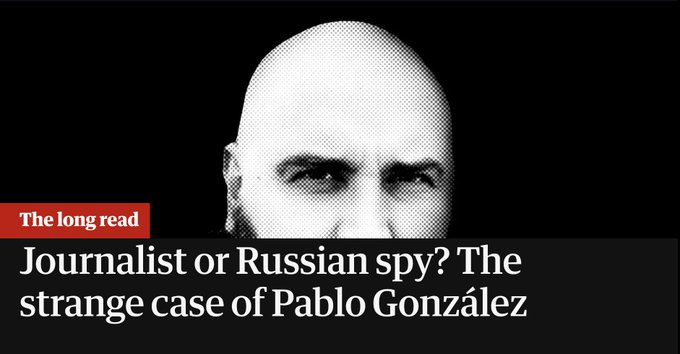
Journalist or Russian spy? The strange case of Pablo González (Guardian)

Imagen

Xavier Colás @xaviercolas
Nuevas revelaciones sobre Pablo González. La más interesante, la de @shaunwalker7 en The @guardian, que se adentra en el contexto familiar de Pablo. Hace tiempo que varias fuentes nos han dicho que su contacto con el GRU puede ser a través de su padre. Walker traza una línea distinta: su madrastra: Para empezar, hay registros de dos Tatiana Dobrenkos diferentes, una nacida en 1954 y otra en 1959, ambas vinculadas al mismo número de seguridad social. Aún más curiosas eran sus direcciones oficiales a lo largo del tiempo. Antes del apartamento donde vivía el padre de González, estaba registrada en el 76 de Joroshevskoye Shosse, [según el reputado investigador

]. Esa dirección, en el noreste de Moscú, alberga un bloque de apartamentos de la era soviética que no tiene nada de especial excepto por una cosa: el enorme edificio que está justo al lado, en el 76B. El edificio es conocido comúnmente como el Acuario y alberga la sede del GRU. “Esto por sí solo no prueba la afiliación con el GRU”, me dijo Grozev. “Pero vemos que también es la dirección de casa de otros funcionarios conocidos del GRU”. Sin duda fue una coincidencia sorprendente para alguien cuyo hijastro ahora estaba acusado de ser un oficial del GRU. Le envié un mensaje a Dobrenko por Telegram pidiéndole un comentario sobre estos registros. Lo leyó y luego me bloqueó sin responder. Todo lo que escribe Shaun merece la pena. La historia, aquí: theguardian.com/world/2024/oct


28 septiembre, 2026
por Felipe Sahagún
Sin comentarios

Reuters launches Reuters Misinformation Monitor


Reuters today announced the launch of Reuters Misinformation Monitor, a new weekly newsletter that delivers real-time intelligence on the global misinformation narratives shaping societies, global markets and policy.
 
In an era when false claims can reshape public discourse, mislead markets and even impact policy decisions, Reuters is bringing its unmatched fact-checking infrastructure directly to readers. Led by Stephanie Burnett, Global Digital Verification Editor, Reuters Misinformation Monitor draws on fact-checking expertise from a team working in 17 languages to track false narratives as they emerge. Each week, the team will break down the week’s most consequential false narratives, offering context and insight into how misinformation travels and influences outcomes.
 

Continue leyendo →

28 septiembre, 2026
por Felipe Sahagún
Sin comentarios

Pedro Sánchez with Joe Stewart

As world leaders gather in New York for the UN General Assembly, Jon is joined by Prime Minister of Spain, Pedro Sánchez. Together, they discuss the future of multilateralism, governing from the left amid the global rise of the far right, and the importance of political conviction in a changing world order. Plus, Jon answers listeners’ questions about the Kennedy Center’s scaffolding and Melania Trump’s light work week!

Celebrating World News Day


28 septiembre, 2026
por Felipe Sahagún
Sin comentarios

World News Day

The video examines the critical relationship between artificial intelligence and the future of public interest journalism, highlighting the risks of inaction and the benefits of strategic investment.

The Current Landscape: One year ago, economists urged governments to invest in public interest journalism, noting that society relies on robust, factual information. Today, AI is more sophisticated and viewed as a top global threat due to its ability to disseminate disinformation at scale. While governments invest heavily in AI for economic growth, the journalism sector faces a severe and worsening financial crisis.

The Risks of Inaction: The global economy loses between 350 and 510 billion US dollars annually to disinformation. As newsrooms close, the lack of professional reporting creates a vacuum likely to be filled by private interests, authoritarian influence, and AI-generated content. This environment threatens to deepen political polarization, destabilize elections, and negatively impact the public.

The Path Forward: Public interest journalism provides significant societal benefits, including financial market stability, the exposure of corruption, and the delivery of reliable information during crises. Experts suggest that dedicating 0.1% of global GDP—equivalent to 15 days of global military spending—could adequately fund public media and secure information environments. Governments are encouraged to create a level playing field between media and big tech companies, similar to laws in Australia that require tech giants to pay levies. Ultimately, a viable, free, and robust media is the best protection against a world dominated by disinformation.