Relaciones Internacionales – Comunicación Internacional

27 agosto, 2025
por Felipe Sahagún
Sin comentarios

At least 5 Gazan journalists killed in Israeli strikes on Nasser Hospital (CPJ)

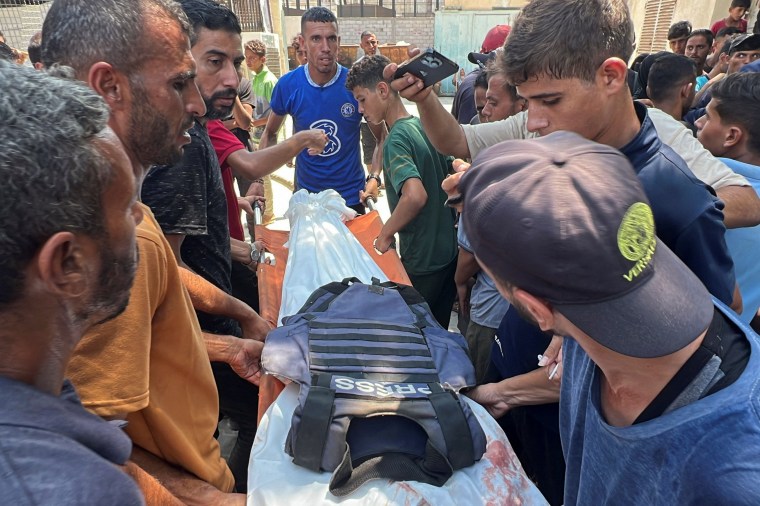
Mourners carry the body of Palestinian camera operator Hussam Al-Masri, who was a contractor for Reuters, after he was killed along with other journalists and people in Israeli strikes on Nasser hospital, in Khan Yunis in the southern Gaza Strip, August 25, 2025. (Photo: Reuters/Stringer)

Mourners carry the body of Palestinian camera operator Hussam Al-Masri, who was a contractor for Reuters, after he was killed along with other journalists and people in Israeli strikes on Nasser Hospital, in Khan Yunis in the southern Gaza Strip, on August 25, 2025. (Photo: Reuters/Stringer)

Updated on 

New York, August 25, 2025—The Committee to Protect Journalists condemns the Israeli strikes that killed five journalists in Nasser Hospital in southern Gaza and calls for the international community to hold Israel accountable for its continued unlawful attacks on the press.

Journalist Hussam Al-Masri, a Reuters contractor; Al Jazeera camera operator Mohammed Salama; Mariam Abu Dagga, freelance photojournalist with Independent Arabia and the Associated Press; freelance journalist Ahmed Abu Aziz, who contributes to Quds Feed; and freelance video journalist Moaz Abu Taha, were among at least 20 people killed in two Israeli strikes on the Nasser Hospital in Khan Yunis, southern Gaza, on Monday morning. Al-Masri was killed in the first strike, while the others were killed while covering the aftermath of the previous Israeli strike. Journalist Jamal Baddah from Palestine Today TV, photographer Hatem Khaled, a Reuters contractor, and Mohammed Fayeq, a freelance photographer, were injured in the attack.

…MORE

Related

Journalistes morts à Gaza : dans une tribune, de nombreuses sociétés de journalistes se joignent à la mobilisation de Reporters sans frontières (Le Monde)

Que veut cacher Israël en imposant le huis clos à Gaza ? (Editorial Le Monde)

The deadly toll on journalists in the Gaza war (Guardian)

Brothers, cousins, sons: the human stories behind four of the war’s fallen journalists (Guardian)

The risks of reporting in Gaza (NYT, August 27)

OSINT, aid flights and trusted contacts: how journalists are covering Gaza’s story from afar (Reuters Inst)

Covering Israel-Gaza war (Reuters Inst)

Global media outlets unite to protest Israel’s killing of journalists in Gaza (CNN)

Movilización internacional de los medios de comunicación  (RsF)

RSF y Avaaz llaman a los medios de todo el mundo a sumarse a una iniciativa global (RsF)

Al menos cuatro periodistas asesinados por el ejército israelí en Gaza (RsF)

La APM anima a sus asociados a participar en el apagón de portadas para poner fin a los ataques contra periodistas de Gaza (APM)

Cientos de medios de comunicación se suman a la acción global contra el asesinato de periodistas en Gaza (EFE)

CPJ demands a complete investigation into Israel’s killing of 5 journalists at Nasser Hospital (CPJ)

El riesgo mortal de ser los ojos del mundo en la Franja de Gaza (El Mundo)

MORE ON JOURNALISM IN GAZA 

  • On the work of Palestinian journalists on the ground. | Read
  • An interview with CPJ’s Jodie Ginsberg on why Palestinian journalists should be protected. | Read
  • An interview with independent journalist Plestia Alaqad. | Read
  • On the Israeli news outlets reporting on war crimes. | Read
  • An interview with AFP’s Phil Chetwynd on how they protect their own journalists in Gaza. | Read

Journalists killed in Gaza (AJE)

Cuadernos de Periodistas nº 47

15 agosto, 2025
por Felipe Sahagún
Sin comentarios

What’s at stake at the Trump-Putin Ukraine peace summit? (Guardian)

Imagen

These are the key issues the leaders of the US and Russia will need to resolve to achieve an end to the war in Ukraine

Few believe that Friday’s Trump-Putin summit in Alaska will pave the way for a breakthrough. Russia and Ukraine remain far apart – with the Kremlin seeking to dominate its smaller neighbour while Kyiv wants to move decisively into the western sphere.

Here are some of the key issues that will need to be addressed to reach a meaningful peace settlement.

…MORE


15 agosto, 2025
por Felipe Sahagún
Sin comentarios

Russia’s future (The Jamestown Foundation)

The conference “Russia’s Future: A Challenge for U.S. Policy” was jointly organized by The Jamestown Foundation, Delphi Global Research Center, and the Free Nations of Post-Russia Forum (@freepostrussia).

About the Event

Russia’s full-scale invasion of Ukraine in February 2022 turned Moscow’s longtime campaign against Kyiv into a global war. The Kremlin’s attempted conquest of Ukraine has been backed by Chinese industrial might, North Korean military supplies and troops, and Iranian drones and missiles. Moscow has intensified its campaigns of sabotage and subversion against Europe in order to undermine international support for Ukraine. The intensifying war effort, however, has only succeeded in further degrading the failing Russian state. The Kremlin’s imperial ambitions in Ukraine come at the cost of potential mutinies, fracture, and dissolution at home.

Understanding the consequences of Russia’s deteriorating internal conditions was the main topic of the conference, which involved experts in foreign affairs, defense, and geopolitics, along with representatives of Russia’s captive nations long-recognized by the United States. Russia is one of the globe’s last colonial empires, denying captive nations the right to self-determination and independence. Whether it remains an aggressive imperial power committed to threatening its neighbors or otherwise devolves into fracturing states, U.S. and allied policymakers cannot afford to ignore Russia’s future.


13 agosto, 2025
por Felipe Sahagún
Sin comentarios

Ensuring a Secure and Sovereign Ukraine (CFR)

With the Russia-Ukraine war now in its fourth year, the future of Ukraine remains unclear. Ensuring that Ukraine is able to resist and survive Russia’s full-scale invasion is essential to restore peace and security to Europe. With this goal in mind, the Council’s Special Initiative on the war in Ukraine provides timely, informed analysis and practical policy recommendations for U.S. policymakers and the American public.

 Watch Introduction Video

Related

The Carrot-Stick Approach to Ending the War in Ukraine (Charles A. Kupchan)

The Limits of Putin’s Ambitions (Thomas Graham)


13 agosto, 2025
por Felipe Sahagún
Sin comentarios

Rusia, el gran vencedor (Jorge Heine)

Jorge Heine, exembajador de Chile en China, subraya la relevancia histórica de la próxima reunión entre Donald Trump y Vladimir Putin, al considerar que se trata del primer encuentro entre ambos líderes desde 2019 y el primero entre un presidente estadounidense y su par ruso desde la invasión de Ucrania. Destaca que más allá del conflicto ucraniano, lo que está en juego es la redefinición de la relación entre Moscú y Washington en un contexto global altamente volátil.

Heine también advierte que el acuerdo en discusión no solo implicaría que Rusia retenga las cuatro regiones parcialmente ocupadas, sino que incluiría la exigencia clave de que Ucrania renuncie a su ingreso en la OTAN, algo que Moscú considera esencial para su seguridad. Según el embajador, Europa queda al margen de estas negociaciones, pese a su interés, y el proceso está completamente dominado por Estados Unidos y Rusia.

En cuanto a la situación en Oriente Medio, Heine califica de tragedia humanitaria sin precedentes la ofensiva israelí en Gaza, señalando que la muerte de más de 60.000 civiles, incluidos más de 20.000 niños, ha generado un impacto global, incluso entre aliados históricos de Israel como Alemania, que ya ha suspendido el envío de armas. Critica el papel de Europa por limitarse a declaraciones simbólicas como el reconocimiento del Estado palestino, instando a adoptar medidas concretas como la revisión de acuerdos comerciales con Israel.

Heine alerta de que la pasividad europea frente al sufrimiento palestino está poniendo en entredicho su autodefinición como defensora de los derechos humanos, especialmente en contraste con su apoyo decidido a Ucrania. También cuestiona a efectividad de la ONU y denunció el declive del multilateralismo frente al retorno de la lógica de poder y los intereses imperiales.


11 agosto, 2025
por Felipe Sahagún
Sin comentarios

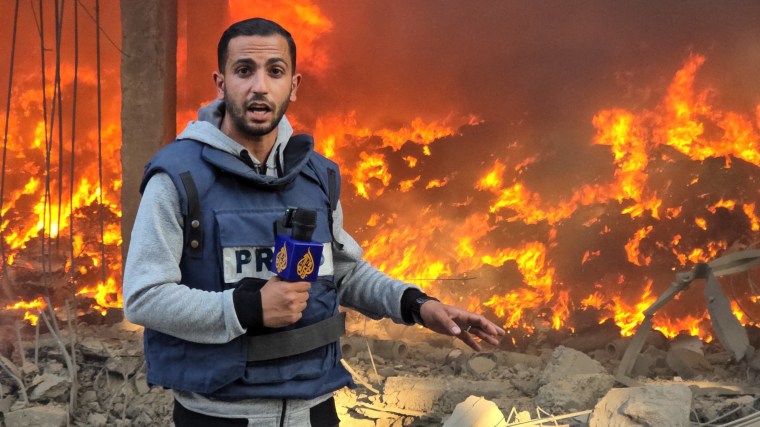
5 AJE journalists, killed by Israel in Gaza

An Israeli army spokesperson had called Al Jazeera Arabic’s Gaza correspondent Anas Al-Sharif a terrorist multiple times before his death in an Israeli airstrike on August 10, 2025.

An Israeli army spokesperson had called Al Jazeera Arabic’s Gaza correspondent Anas Al-Sharif a terrorist multiple times before his death in an Israeli airstrike on August 10, 2025. (File photo: Courtesy of Anas Al-Sharif)

Israel kills Al Jazeera journalists in targeted Gaza City airstrike – Committee to Protect Journalists

New York, August 10, 2025—The Committee to Protect Journalists is appalled to learn of Sunday’s killing of Al Jazeera correspondents Anas al-Sharif and Mohammed Qreiqeh, and camera operators Ibrahim Zaher, Mohammed Noufal, and Moamen Aliwa by Israeli forces in Gaza. The five journalists were killed in an attack on a tent used by media near Al-Shifa Hospital in Gaza City during an Israeli bombardment, according to Al Jazeera.

In a statement announcing the killing of al-Sharif, Israel’s military accused the journalist of heading a Hamas cell and of “advancing rocket attacks against Israeli civilians and [Israeli] troops.”

Israel has a longstanding, documented pattern of accusing journalists of being terrorists without providing any credible proof. 

…MORE

Related

The 184 Palestinian journalists killed in the war in Gaza endured hunger and grief (AP)

Since the war began in Gaza, 184 Palestinian journalists have been killed, according to the New York-based Committee to Protect Journalists. They include men and women, freelancers and staffers, veterans with years in the field and young reporters on some of their first assignments. Some were killed with their families at home, others were in vehicles marked “PRESS,” or in tents near hospitals, or out covering the violence. Many endured the same conditions as those they covered — hunger, displacement, and grief.