Relaciones Internacionales – Comunicación Internacional

4 mayo, 2018
por Felipe Sahagún
Sin comentarios

La excepcionalidad de Kosovo

No todos los problemas tienen solución y, desde luego, no todos ofrecen una solución que llegue a satisfacer a las partes enfrentadas. Kosovo es un ejemplo claro. Cuando una parte de la comunidad internacional, con EE UU a la cabeza, decidió impulsar la independencia de esta antigua provincia serbia se metió en un jardín legal del que resultaba difícil salir sin saltarse principios del derecho y sin romper promesas que se realizaron en tiempos de guerra. Continue leyendo →

4 mayo, 2018
por Felipe Sahagún
Sin comentarios

ETA y las trampas del lenguaje


Imagen de archivo

ETA ha tenido históricamente una extrema habilidad para medir sus palabras e incluso para imponer su terminología. Ahora que tanto preocupa que el relato de más de 40 años de terror que quede para la historia sea el que escriban los demócratas y no los terroristas, puede resultar útil mirar al pasado y comprobar como los medios de comunicación, los políticos y en último término la sociedad llegamos a utilizar un lenguaje que nos estaban imponiendo los terroristas y su entorno sin que nos diéramos cuenta.

Con la ayuda de Álex Grijelmo, periodista, escritor de varias obras sobre el uso del lenguaje y responsable de libros de estilo como los de la Cadena SER o el diario El País, desgranamos las trampas y la manipulación lingüística que nos impuso durante años la banda terrorista.

Enlace a audio

Pere Ll. Huguet Tous@perehuguet


Relacionados

Terrorismo y medios de comunicación (I). El oxígeno de la publicidad

Terrorismo y medios de comunicación (y II). El lenguaje del «proceso» y su hechizo

Terrorismo y propaganda en los medios de comuniación (Tesis doctoral)

La condena de Rubén Amón: «Condeno a ETA a disolverse en su propio ácido y en su propio hedor»

Propaganda, amenaza y anzuelo

El lenguaje del terrorismo

El PNV valora el lenguaje de ETA pero critica que distinga entre víctimas

Las víctimas de ETA: del ni olvido ni perdón al rechazo del odio y la venganza

La lengua sucia

4 mayo, 2018
por Felipe Sahagún
Sin comentarios

Working With Whistleblowers In The Digital Age: New Guidelines

Working With Whistleblowers research roundtable in Perugia. From left to right: Prof Bruce Shapiro (Dart Center, GIJN), Joyce Barnathan (ICFJ), Rosa Meneses (El Mundo), Joel Konopo (INK), James Risen (The Intercept), Jeff Larson (Pro Publica), Julie Posetti (Reuters Institute for the Study of Journalism/Blueprint for Free Speech). via European Journalism Observatory (EJO)

MAY 3, 2018 • COMMENT, MEDIA AND POLITICS, RECENT, SPECIALIST JOURNALISM • BY 

From Watergate to the Panama Papers, investigative journalism that relies on confidential sources and whistleblowers has proven essential to the maintenance of democracies and open societies internationally.

One of the central ethical tenets of professional journalism is “first, protect your sources”. This principle is enshrined in professional codes internationally, while laws have been developed over decades to support this ethical commitment. In the analogue era, such normative and regulatory frameworks enabled journalists to stand up in court – sometimes on pain of jail – and refuse to reveal their sources.

But Digital Age threats like the the ‘trumping effect’ of national security over reach, the ever widening nets woven by mass and targeted surveillance, and attempts by governments to undermine encryption have thrown up a host of new risks for journalists and human rights defenders working with whistleblowers. That’s a development acknowledged by Pulitzer Prize-winning investigative journalist James Risen. “It’s obviously becoming more dangerous today to do good investigative reporting anywhere in the world,” Risen said, speaking at the recent launch of a new action-research project designed to better equip reporters to deal ethically and responsibly with whistleblowers in the post-Snowden era.

…MORE


3 mayo, 2018
por Felipe Sahagún
Sin comentarios

Syria: the world’s war

Syria is now into its eighth year of war. What kind of future could the country have if the end came into sight? We hear from the UN secretary-general Antonio Guterres who has been speaking to the BBC, and fromour chief correspondent Lyse Doucet who has been making a documentary about the war.

Link to Documentary Broadcast on May 3, 2018

https://www.bbc.co.uk/iplayer/episode/b0b1v4jp/syria-the-worlds-war-series-1-episode-1

What Future For Syria? (ISPI, Med Dialogues)

Seven years into the conflict, the future of Syria still remains undefined. Despite the fact that the Islamic State has been defeated, while the Syrian regime has increasingly recovered strength and ground, the struggle for control of portions of the country, sectarianism and violence continue to fuel the war. Conflicting interests of different local players and external actors further contribute to fomenting the chaos. Starting from an evaluation of the latest developments and broader local, regional and international dynamics the workshop aims to stimulate a debate among policy planners, officials and experts on a long-term arrangement for Syria, taking into account the strategic interests of different stakeholders. (April 24, 2018)


3 mayo, 2018
por Felipe Sahagún
Sin comentarios

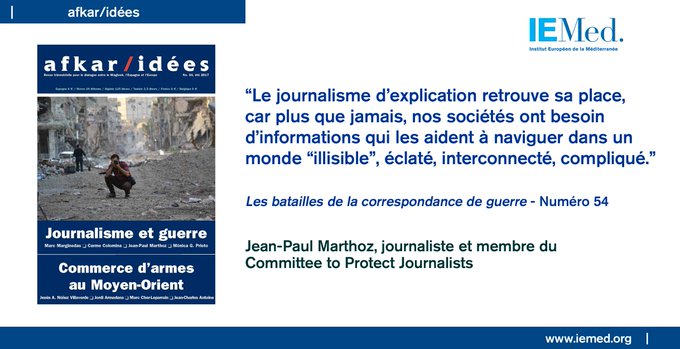
Les batailles de la correspondance de guerre

Ver imagen en Twitter

IEMed@IEMed_