Relaciones Internacionales – Comunicación Internacional

7 abril, 2024
por Felipe Sahagún
Sin comentarios

Age of Revolutions (F Zakaria)

Image

On GPS, at 10 a.m. and 1 p.m. ET:

First, Fareed gives his take on a phenomenon that may seem odd but in fact fits with our social and political times: Trump rallies taking on religious overtones.

As Fareed outlines in his new book, “Age of Revolutions: Progress and Backlash from 1600 to the Present,” rapid secularization has been among the most significant social trends in America in recent decades. As religion recedes—and as strict doctrine becomes less prevalent within it—politics have stepped in to fill the void, Fareed says: nationalist, populist, authoritarian politics, specifically. Continue leyendo →

6 abril, 2024
por Felipe Sahagún
Sin comentarios

Si Donald Trump gana las elecciones

Miguel Á. Muñoz-Encinas

Madrid. Cadena SER05/04/2024 – 10:12 CEST

El 5 de noviembre, los norteamericanos volverán a las urnas para decidir quién ocupa la Casa Blanca los próximos cuatro años. Salvo sorpresa, Joe Biden y Donald Trump reeditarán el duelo de 2020 que terminó con el asalto al Capitolio el 6 de enero de 2021 por parte de una muchedumbre jaleada por el entonces presidente saliente.


6 abril, 2024
por Felipe Sahagún
Sin comentarios

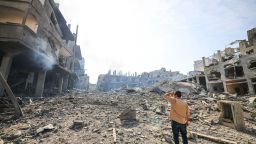
Six months into the war in Gaza (CNN, Brookings, Guardian..)

Palestinians ride bicycles past the ruins of houses and buildings destroyed during Israel’s military offensive, amid the ongoing conflict between Israel and Hamas in the northern Gaza Strip.

Brookings

6 months on: The impact of the war in Gaza

Nearly six months after Hamas’s attack on October 7 and Israel’s subsequent invasion of the Gaza Strip, Brookings experts reflect on the conflict and humanitarian crisis.

Read more

CNN

No exit strategy and no real plan for the future

Gaza aid efforts dealt major blow

No winners

Related

After six months, the war in Gaza is making Israel a pariah state (Guardian,


5 abril, 2024
por Felipe Sahagún
Sin comentarios

Thirty Years After Rwanda’s Genocide

A map of Rwanda with important points such as area (slightly smaller than Maryland) and population (13.4 million)

April 3, 2024 2:03 pm (EST)

After the 1994 genocide in Rwanda, the country has made tremendous strides toward peace and development. But critics say these have come at the cost of political freedoms.   

April 7 marks thirty years since the Rwandan genocide, in which a radical faction from the majority Hutu ethnic group launched a campaign to eradicate the ethnic Tutsi minority and other opponents, divisions some experts say were fueled by the legacy of Belgian colonial policies of ethnic identification. The one-hundred-day massacre saw at least eight hundred thousand people killed. In the years since, Rwanda has sought to rebuild society by focusing on reconciliation and economic development, efforts that have been shrouded in controversy under the authoritarian rule of the country’s longtime leader, President Paul Kagame.

How did Rwanda approach reconciliation?

The genocide ended with the military victory of the Tutsi-led political group and today’s ruling party, the Rwandan Patriotic Front (RPF), headed by current President Paul Kagame. A new, RPF-led government then pursued a nationwide approach of “unity and reconciliation” [PDF]. It also developed a new constitution that underscored equality of Rwandan citizens and discouraged any forms of public identification based on ethnic grouping, to emphasize social cohesion. However, a Human Rights Watch report later noted that these efforts were heavily marred by forced relocation, reeducation camps for followers of the previous government, and other extreme measures. 

…more

Amanpour Scream Bloody Murder

From the archives: Murder and reconciliation in the Rwandan genocide


The man who tried to prevent the Rwandan genocide

In this report from 2008, Christiane Amanpour speaks to a U.N. Commander about his desperate, futile attempt to stop the Rwandan genocide.
 
 
Related

5 abril, 2024
por Felipe Sahagún
Sin comentarios

India’s 2024 General Election: What to Know (CFR)

Supporters of Bharatiya Janata Party (BJP) cheer after India’s Prime Minister Narendra Modi’s roadshow in Ayodhya, Uttar Pradesh, India.

The election date for the world’s largest democracy is set to begin April 19 and last six weeks. What would the results of a third term for Prime Minister Modi mean for India’s economy, democracy, and position in the Global South? 

April 2, 2024 1:15 pm (EST)

Who are the major contenders to watch in these elections?

India has a multiparty parliamentary government with a bicameral legislature. This year’s elections—set to begin April 19—are for India’s lower house of Parliament, the Lok Sabha, which has 543 seats. The party or coalition of parties that wins a majority will nominate a candidate for prime minister and form a ruling government.

…MORE


5 abril, 2024
por Felipe Sahagún
Sin comentarios

NATO’s 75th Birthday (FP, The Atlantic Council…)

History was made in the unimaginatively named Departmental Auditorium. That is the Washington, DC, room where, seventy-five years ago today, the North Atlantic Treaty was signed by representatives from twelve nations. The Alliance the treaty created, NATO, was born following two destructive world wars and a reasonable fear that Soviet aggression might soon set off a third. The Alliance sought to establish peace at a moment when such a notion seemed almost rebellious.

Seventy-five years is a long time. Long enough, at least, to take some things for granted. It’s reasonable to claim that this applies to the Alliance and the peace that it has helped ensure for its members for seventy-five years. NATO is nowadays seen as such a staple of the security architecture in the North Atlantic that even its members sometimes forget to reflect on just how powerful, diverse, and foundational to the modern world it has become.

…MORE

Continue leyendo →