Relaciones Internacionales – Comunicación Internacional

11 julio, 2023
por Felipe Sahagún
Sin comentarios

Hotline pour les journalistes couvrant les violences urbaines

Chers amis,

Alors que les violences envers les journalistes ne cessent de progresser en France ces derniers mois, Reporters sans frontières (RSF) a lancé une hotline afin de répondre aux besoins urgents des journalistes ayant couvert la montée des tensions après le décès de Nahel, tué par un policier le 27 juin à Nanterre.

La “hotline RSF violences urbaines” a permis aux journalistes couvrant les violences urbaines d’accéder à des services d’urgence. Les professionnels pouvaient signaler les exactions dont ils sont victimes, bénéficier d’un conseil juridique, d’une assistance psychologique, de prêts de matériel de protection et de formations à la sécurité des journalistes sur le terrain.

La montée des agressions contre les journalistes est une source de préoccupation majeure pour RSF. Les reporters sont les témoins indispensables de cette actualité. Nous ne pouvons pas accepter qu’ils soient pris en étau entre les manifestants, les émeutiers et les forces de l’ordre. Il est de notre responsabilité, à RSF, d’appeler tous les protagonistes à la plus grande retenue et de proposer des solutions concrètes, comme nous le faisons partout dans le monde.

Votre soutien est essentiel afin de nous permettre de continuer à agir efficacement pour la protection des journalistes qui font courageusement face aux violences dans le but d’informer.

Merci pour votre mobilisation.

JE FAIS UN DON
–
REPORTERS SANS FRONTIÈRES (RSF)
Vladimir de Gmeline, Directeur des crises

11 julio, 2023
por Felipe Sahagún
Sin comentarios

Turkish president’s decision to support NATO membership for Sweden

Atlantic Council

Everything you need to know about the Turkish president’s decision to support NATO membership for Sweden.

JUST IN: The wait is (nearly) over. After more than a year of ups and downs since Sweden applied to join NATO in May 2022, Turkish President Recep Tayyip Erdoğan has agreed to back Stockholm’s bid to become the Alliance’s thirty-second member. The announcement came on the eve of the NATO Summit in Vilnius after Erdoğan, NATO Secretary General Jens Stoltenberg, and Swedish Prime Minister Ulf Kristersson held a lightning round of negotiations. Erdoğan agreed to advance ratification of Sweden’s NATO accession to Turkey’s legislature, with Hungary expected to follow suit to complete the process. What changed Erdoğan’s mind? What’s next for the Alliance? Our experts on the ground in Vilnius and beyond share their insights.. Continue leyendo →

10 julio, 2023
por Felipe Sahagún
Sin comentarios

Truth-telling in a time of war (Ukraine, EJNetwork)

 
Meeting : Ethical Journalism Network’s Ukraine Media Report

8 julio, 2023
por Felipe Sahagún
Sin comentarios

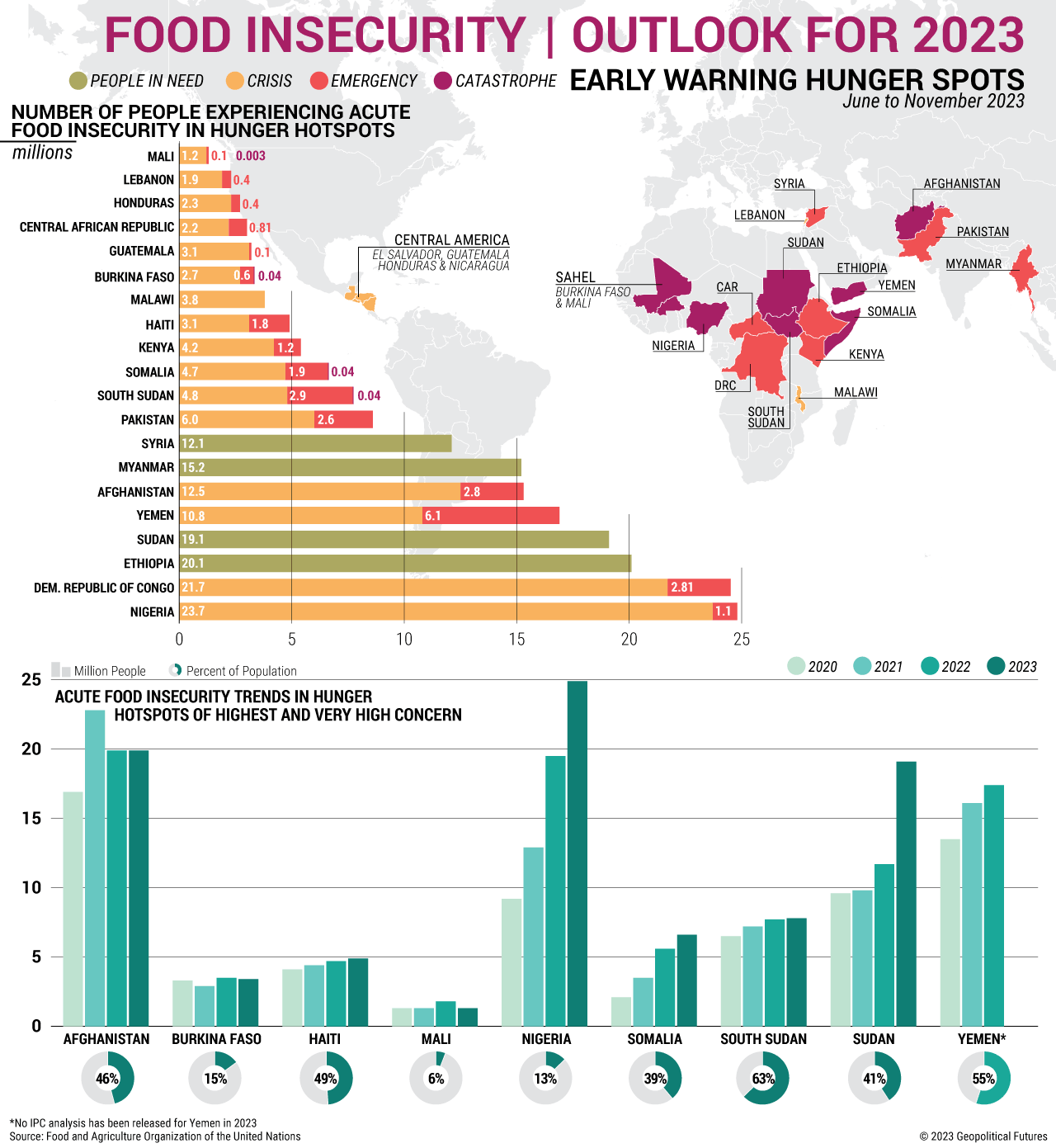
Food Insecurity: Outlook for 2023 (Geopolitical Futures -June 2, 2023)


Food Insecurity | Outlook for 2023

Over the course of 2022, global food prices gradually began to ease. However, this wasn’t necessarily reflected in prices at local markets in countries experiencing food insecurity. Countries that rely on food imports and have low foreign reserves are at greatest risk of seeing a lack of access to food. Costly agricultural input materials, labor and energy also contribute to high food costs.

Notably, the food gap between advanced and developing economies is growing. Developed countries tend to have stronger currencies and better access to credit, meaning food supplies and input materials are generally more affordable and accessible than in developing economies. The most vulnerable countries, however, are often forced to work with institutions like the International Monetary Fund to secure financing to pay for imports. Different countries have varying degrees of success in these negotiations, but it’s generally a challenging path as meeting IMF requirements is for many governments constrained by political considerations at home.

…MORE


7 julio, 2023
por Felipe Sahagún
Sin comentarios

NATO after the Vilnius summit

NATO’s Next Decade

Nine thinkers assess the alliance’s future ahead of a historic summit.

 
July 6, 2023
 

What was NATO before Russia’s invasion of Ukraine? A Cold War relic in search of a mission, a drain on Washington as it pivoted to Asia, a needless irritant to a nonthreatening Russia—or so a chorus of academic and media pundits told us. French President Emmanuel Macron, Europe’s pundit-in-chief, famously summed up the mood by calling the alliance “brain-dead.”

Countries closer to Russia knew differently, of course, and tirelessly warned their western peers that the alliance still served a vital purpose. Today, in many ways, NATO is back to its roots as a bulwark of the trans-Atlantic West against an expansionist Kremlin. Weapons are heading east, and troops are being forward-deployed. Seeking the bloc’s traditional protection, Finland has joined, Sweden is in the waiting room, and Ukraine’s path to membership will be discussed when NATO leaders meet for their annual summit in Vilnius, Lithuania, next week. All of a sudden, we’re talking about the defense-industrial complex again, tallying ammunition production and counting tanks.

But this is no return to the past, even if some might be nostalgic for the sense of unity and purpose that seemed to define the West during the Cold War. Having brought that epic contest to a peaceful close without a major conflagration arguably made NATO the most successful military alliance in history. Today, however, the bloc operates in a very different world, where Moscow is just one challenge of many. As allies of Russia, China and Iran now impact European security directly; NATO, in turn, is eyeing new threats to the east.

…MORE

Future of NATO -PdF-  F P olicy (July 6, 2023)

Related

Don’t Let Ukraine Join NATO. The Costs of Expanding the Alliance Outweigh the Benefits -By

Western Europe Is Still Falling Short in NATO’s East. Deterring Russia Requires More Than Just Promises -By