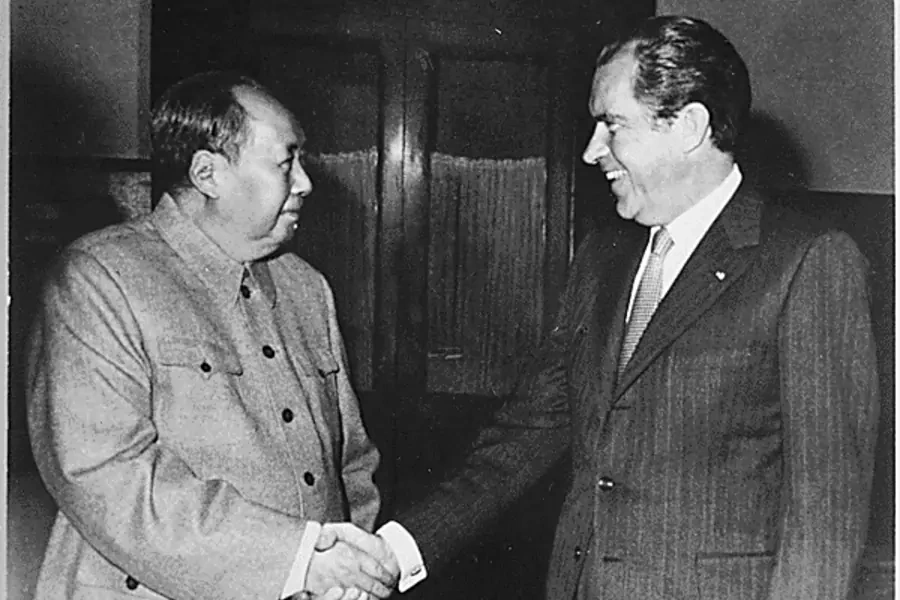
President Richard Nixon and Chairman Mao Zedong shake hands on February 21, 1972. National Archives v CFR
Visualizing 2022: Trends to Watch
Ten Elections to Watch in 2022
The World Next Year: What to Watch in 2022
Ten Anniversaries to Note in 2022

17 diciembre, 2021
por Felipe Sahagún
Sin comentarios
President Richard Nixon and Chairman Mao Zedong shake hands on February 21, 1972. National Archives v CFR
Visualizing 2022: Trends to Watch
Ten Elections to Watch in 2022
The World Next Year: What to Watch in 2022
Ten Anniversaries to Note in 2022
17 diciembre, 2021
por Felipe Sahagún
Sin comentarios

One good thing can be said about 2021: it wasn’t as tumultuous as 2020, which put in a claim to be the worst year ever. That, however, may be damning with faint praise. Yes, the past twelve months did bring some good news. Indeed, for a moment in early summer it seemed that COVID-19 was in the rearview mirror. However, it isn’t. And 2021 brought other bad news. So here are my top ten world events in 2021. You may want to read what follows closely. Several of these stories will continue into 2022 and beyond.
…MORE
17 diciembre, 2021
por Felipe Sahagún
1 comentario

Texto finalizado el 14 de diciembre de 2021. Esta Nota Internacional es el resultado de la reflexión colectiva del equipo de investigación de CIDOB en colaboración con EsadeGeo. Coordinada y editada por Eduard Soler i Lecha, en el proceso de redacción ha contado con aportaciones de Hannah Abdullah, Inés Arco, Anna Ayuso, Jordi Bacaria, Ana Ballesteros, Pol Bargués, Moussa Bourekba, Anna Busquets, Carmen Claudín, Carme Colomina, Emmanuel Comte, Carlota Cumella, Anna Estrada, Francesc Fàbregues, Oriol Farrés, Agustí Fernández de Losada, Blanca Garcés, Eva Garcia, Andrea G. Rodríguez, Juan Garrigues, Francis Ghilès, Seán Golden, Berta Güell, Juan Ramón Jiménez-García, Francesca Leso, Josep Mª Lloveras, Rafael Martínez, Esther Masclans, Óscar Mateos, Sergio Maydeu, Elisa Menéndez, Pol Morillas, Yolanda Onghena, Umut Özkirimli, Francesco Pasetti, Cristina Sala, Héctor Sánchez, Ángel Saz, Reinhard Schweitzer, Antoni Segura, Cristina Serrano, Eloi Serrano, Marie Vandendriessche, Pere Vilanova y Eckart Woertz, así como de socios individuales de CIDOB en los trabajos preparatorios.
En 2022 el mundo tiene más certezas sobre los desafíos a los que se enfrenta y es más consciente de su vulnerabilidad e interdependencia. El futuro siempre es incierto, pero la incertidumbre ahora no es tanto sobre el qué, sino sobre el cómo, el quién y el hasta cuándo. No es un problema de diagnóstico. Sobran datos y conclusiones sobre la trascendencia del momento actual, y de las grandes transiciones en curso como la digital, la verde o la laboral. Sin embargo, la incapacidad para llevarlas a cabo de forma colectiva e inclusiva nos sitúan en un escenario de fractura. El debate se centra en saber dónde están los límites de una posible irreversibilidad, qué tipo de liderazgo está mejor preparado o goza de mayor legitimidad para pilotar estas transformaciones y cuál es la mejor fórmula para gestionar este proceso de cambio con los menores costes sociales posibles.
¿Y qué hace de 2022 un año especial? Los avances en materia de vacunación deberían garantizar que en algún momento del año –quizás más tarde de lo esperado inicialmente– se pueda hacer el recuento de daños y mirar hacia delante. Así pues, uno de los grandes temas del año será la tan ansiada recuperación y todo aquello que puede frustrarla (precios, tensiones geopolíticas, malas noticias en el ámbito sanitario). En este proceso de arranque pospandémico será evidente que el mundo no solo avanza a distintas velocidades, sino que hay retrocesos para algunos colectivos, por ejemplo, en movilidad y crisis humanitarias. Y una de las preguntas más recurrentes que se oirá este año será si del shock de la pandemia hemos aprendido a afrontar los retos globales con más anticipación, ambición y solidaridad.
Related
What will 2022 bring? (Emma Ashford ew and MatthKroenig, Foreign Policy, Dec 17, 2021)
Big Issues 2022(Jim O’Neill, Dec 9, 2021, Project Syndicate)
PS Predictions for 2022 (Dec 17, 2021)
2021 Overview (World Politics Review, Dec 17, 2021)
15 diciembre, 2021
por Felipe Sahagún
Sin comentarios

Brendan Simialowski/Getty Images v @nytimes
Dec 15, 2021
With the midterms just months away and the 2024 presidential race around the corner, the press is gearing up to cover more deeply polarizing election cycles.
And how it should do that is an equally polarizing question. The media’s role in preserving — and reporting on — our democratic institutions is up for discussion.
Last week, the New York Times Opinion columnist Ross Douthat pushed back on media critics like the N.Y.U. associate professor Jay Rosen. Jay asserts that the press should strive to be “pro-truth, pro-voting, anti-racist, and aggressively pro-democracy.”
Ross disagrees, claiming that such a stance could feed more polarization.
15 diciembre, 2021
por Felipe Sahagún
Sin comentarios

Beverly Kirk Senior Associate (Non-resident), International Security Program
Good Judgment Project Superforecaster Regina Joseph explains geopolitical forecasting, including its use in predicting armed conflicts and election outcomes. She also discusses its connection to artificial intelligence and usefulness to policymakers.
Related
U.S. builds new software tool to predict actions that could draw China’s ire
15 diciembre, 2021
por Felipe Sahagún
Sin comentarios

UNITED NATIONS, New York — UNFPA launched its annual humanitarian report today, revealing a critical need to scale up assistance for crisis-affected populations. The organization is appealing for $835 million to reach 54.5 million women, girls and young people in 61 countries with life-saving sexual and reproductive health services in 2022.
For the third year in a row, humanitarian funding needs are greatest in Yemen, where some $100 million is required for urgent support. Reproductive health services have been critically undermined by conflict and the COVID-19 pandemic; the most recent estimates hold that every two hours, a woman in Yemen dies in childbirth, and more than a million pregnant and breastfeeding women are acutely malnourished.
Dr. Samar, in the district of Jiah, sees women in life-threatening danger far too often, he said.
Not long ago, a woman named Safiya was carried by her husband to Dr. Samar’s clinic; she was in shock from an ectopic pregnancy.
«I told Safiya’s husband about the need for an urgent surgical intervention to save her life,» Dr. Samar recounted. «His eyes were filled with tears, devastated…. [he said] ‘I don’t have the money to hire a car to get to the hospital.»