Relaciones Internacionales – Comunicación Internacional

25 agosto, 2021
por Felipe Sahagún
Sin comentarios

Afghanistan under the Taliban (Aug 25, 2021)

Updated 8.25.21 event.png

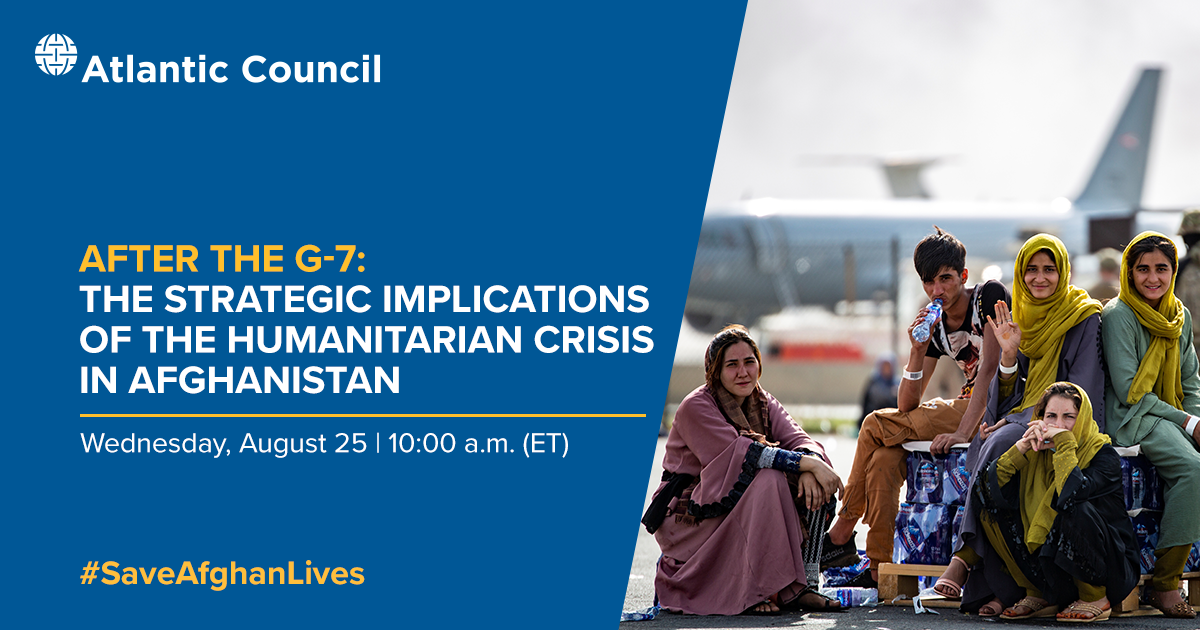
After the G7: The Strategic Implications of the Humanitarian Crisis in Afghanistan 

The urgent effort to evacuate US citizens and at-risk Afghans is only the front end of a longer-term, grave, and large-scale humanitarian crisis, as well as a direct challenge to US global credibility. Up to this point, the evacuation operations have been challenged on a variety of levels, including communications with potential evacuees, ensuring the safety of evacuees in getting to the airport, logistics, capacity, as well as security along the route to the Kabul airport.

Following today’s G-7 meeting and President Biden’s decision to maintain the August 31st withdrawal deadline, what are the next steps for the United States and allies? Which policies should be enacted to ensure a safe and swift evacuation? How must the United States and its allies and partners address the unfolding and long-term humanitarian crisis? Today’s joint statement following the G-7 leaders meeting about this crisis stressed the need for a longer-term framework for dealing with the Taliban, and protecting global security and regional stability.

Join the Atlantic Council’s Scowcroft Center for Strategy and Security, South Asia Center, and Rafik Hariri Center & Middle East programs for a conversation following up on the G-7 Leaders meeting about efforts to evacuate US citizens and allies as well as at-risk Afghans from Afghanistan amid a deteriorating security and humanitarian situation.

A panel discussion featuring:

Lord Mark Malloch-Brown
President
Open Society Foundations

General James E. Cartwright, USMC (Ret.)
Former Vice Chairman of the Joint Chiefs of Staff
Board Director
Atlantic Council

Ambassador Melanne Verveer
Executive Director of the Georgetown Institute for Women, Peace and Security
Georgetown University

Rina Amiri
Senior Fellow, Center for International Cooperation
New York University

M. Lyla Kohistany
Nonresident Senior Fellow 
Forward Defense, Scowcroft Center for Strategy and Security
Atlantic Council

Moderated by Vivian Salama
National Security Reporter
Wall Street Journal
Event image

Dear felipe,

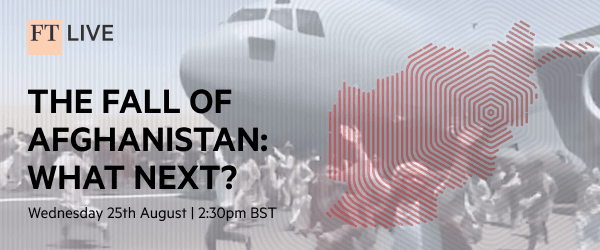
We look forward to welcoming you shortly for The Fall of Afghanistan: What Next?, our subscriber-exclusive digital event. 

The webinar will start at 2:30pm BST (GMT+1) . To access the broadcast, please click the button below.

With expert speakers and leading FT journalists:

General David H. Petraeus
former Director
Central Intelligence Agency
 
Ajmal Ahmady
former Central Bank Governor
Afghanistan
 
Katrina Manson
US Foreign Policy and Defence Correspondent
Financial Times
 
Stephanie Findlay
South Asia correspondent
Financial Times
 
Moderated by 
Peter Spiegel
US Managing Editor
Financial Times

The geopolitical and humanitarian implications of the Taliban takeover

It took just 10 days after the withdrawal of US troops for the Taliban to take over Afghanistan, culminating in their lightning entry into Kabul and a humiliating indictment of the US campaign of the last 20 years.

While the Taliban themselves admitted surprise at the speed of their victory, they now have to rule as they prepare to proclaim a new Islamic Emirate of Afghanistan. Responding to allegations of a catastrophic failure of US intelligence, Antony Blinken, secretary of state, conceded only that US analysis of Afghan military weaknesses was misjudged.

As the 20th anniversary of the Afghan-hatched 9/11 attacks on the US approaches next month, the chaotic evacuation of the US embassy evoked comparisons with the fall of Saigon, although President Biden has stood by his domestically-led decision to withdraw, saying it has been vindicated by the speed of the Afghan government’s collapse.

The image of desperate Afghans clinging to aircrafts taking off from Kabul airport have prompted calls for a global response to an expected exodus of refugees with the potential to turn into a humanitarian disaster.

Join the FT’s in-depth panel as our journalists and other experts discuss what’s next for Afghanistan following the return of the Taliban. They will examine what is in store for Afghans, in particular women and girls; how the Islamist group will rule; and what the geopolitical implications are for key powers and neighbours in both the west and east

TALKING POINTS

-How did the Taliban succeed in taking Afghanistan so quickly?

-How will they rule and how much of the country will they control? 

-Geopolitical implications: What will western allies do? How will China, Iran, Russia, Pakistan and India pursue their interests?

-Will Afghan territory once again become a haven for the sort of terror attacks that prompted the US invasion 20 years ago?

-Afghan exodus: What will the global response be and do countries involved in the conflict have a moral duty to accept refugees? 

-Will women and girls lose all the rights they regained in the past 20 years?
Hi Felipe,
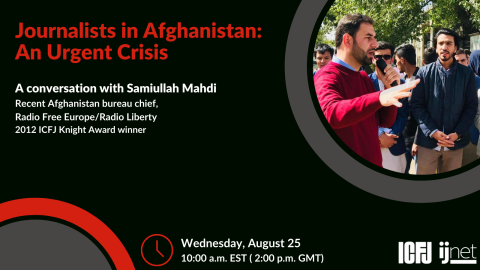
This is a reminder that «Journalists in Afghanistan: An Urgent Crisis» will begin in 1 day on:
Date Time: Aug 25, 2021 10:00 AM Eastern Time (US and Canada)

As the Taliban has taken back Afghanistan with lightning speed, the country’s independent journalists are facing dire consequences. Those who have worked with U.S. and European news media have a target on their backs and are desperately trying to leave. And those working for Afghan media — especially women — fear the coming crackdown on any independent reporting.

Join us Aug. 25 at 10 am EST for a discussion with Samiullah Mahdi, former ICFJ Knight International Journalism Award winner and recent Afghanistan bureau chief for Radio Free Europe/Radio Liberty. Mahdi left Afghanistan hours before the Taliban took control of Kabul. The moderator will be Patrick Butler, ICFJ’s Vice President of Content and Community.


24 agosto, 2021
por Felipe Sahagún
Sin comentarios

Bulos y desinformaciones sobre la llegada al poder de los talibanes en Afganistán (Maldito Bulo)

El pasado 15 de agosto los talibanes entraron en Kabul, capital de Afganistán, hecho que supuso la salida del país de su presidente, Ashraf Ghani. Desde entonces son varios los bulos y desinformaciones que han circulado al respecto: un fotomontaje con la supuesta bandera talibán sobre el palacio presidencial, una imagen de la supuesta «evacuación de 800 personas en un avión de las fuerzas aéreas norteamericanas en Kabul», un vídeo de una supuesta ejecución de una mujer…

En situaciones de alarma social los desinformadores tratan de sembrar el caos. Por ello, es importante que os fieis solo de fuentes oficiales y ante la duda, no compartas. Si recibes un contenido que quieres que verifiquemos puedes mandárnoslo a través de WhatsApp al +34 644 22 93 19. Estos son algunos de los bulos que te van a intentar colar: 

No, este vídeo de una ejecución de una mujer no es de Afganistán ni es actual: es Siria y se difunde desde al menos 2014

“Esto sucede hoy en #Afganistan [sic]. Ahora es crimen que la mujer quiera estudiar, por no aceptar ser un objeto sexual, por querer estudiar”. Este es uno de los mensajes que se están difundiendo junto a un vídeo en el que una mujer con velo es ejecutada en frente de varios hombres. Es un bulo: son unas imágenes grabadas en Siria y llevan circulando al menos desde 2014. 

…MORE

Related

VerificaRTVE


24 agosto, 2021
por Felipe Sahagún
Sin comentarios

El colapso de Afganistán (TVE)

El TD2 analiza y profundiza la crisis abierta en Afganistán tras la llegada de la insurgencia talibán a Kabul y el fin del gobierno democrático que ha durado 20 años. Carlos Franganillo contará con expertos y analistas para descifrar la dimensión de lo que está ocurriendo, conectará con la red de corresponsales de RTVE para analizar las reacciones y el papel de las potencias occidentales en estas dos décadas y también buscará respuestas a lo que puede ocurrir a partir de ahora. (16 de agosto de 2021)

Related

Informe Semanal (21 de agosto)

Documental: «Afganistán: bienvenido al territorio talibán»


24 agosto, 2021
por Felipe Sahagún
Sin comentarios

El fracaso en Afganistán (Pedro Baños en Periodista Digital)

Pedro Baños -analista, escritor y conferenciante en Geopolítica, Estrategia, Defensa, Seguridad, Terrorismo, Inteligencia y RRII-  es un militar español, Coronel del Ejército de Tierra. En ‘La Segunda Dosis’, el programa que Alfonso Rojo lanza diariamente por el canal de Youtube de Periodista Digital, analiza la toma de Afganistán por parte de los talibán tras veinte años de conflicto. Al respecto, califica esta noticia como un «ridículo» y «fracaso» espantoso tanto para Estados Unidos como para la OTAN, además del gran coste económico que conlleva. (16 de agosto de 2021)


23 agosto, 2021
por Felipe Sahagún
Sin comentarios

25 años de viajes por Afganistán (Gervasio Sánchez)


Imagen

Gervasio Sánchez@gervasanchez

AFGANISTÁN EN EL ABISMO (1) En agosto de 1996 viajé por primera vez a Afganistán. Los talibanes bombardeaban Kabul antes de ocuparla poco después. 25 años después los talibanes avanzan conquistando una capital provincial detrás de otra. La población civil es la gran perdedora. 4:51 p. m. · 9 ago. 2021

Imagen
AFGANISTÁN EN EL ABISMO (2) El país no conoce la paz desde finales de 1979. Son 40 años de guerras continuas que han afectado a varias generaciones y han impedido la mejora de la vida de sus habitantes. En la imagen huérfanos de guerra en una imagen de agosto de 1996 en Kabul.


Imagen

AFGANISTÁN EN EL ABISMO (3) Es uno de los países más minados del mundo. La capital quedó plagada de minas antipersonas durante la guerra civil (1992-1996) entre las facciones islámicas y cada día había decenas de heridos, entre ellos muchos niños. Imagen de agosto de 1996
 
Imagen
 
AFGANISTÁN EN EL ABISMO (4) En 2001 los talibanes fueron expulsados del poder.En 20 años la llamada comunidad internacional es incapaz de imponer un sistema no corrupto en uno de los países más pobres y se ha apoyado en criminales de guerra para generar el rechazo de los afganos
 
Imagen
 
AFGANISTÁN EN EL ABISMO (5) En setiembre de 1996 los talibanes ocuparon Kabul. Sus habitantes no aplaudieron, pero los aceptaron como mal menor hartos de la violencia de las milicias islamistas que luchaban unas contra otras. En la imagen talibanes amputados por minas en 1997
 
Imagen
 
AFGANISTÁN EN AL ABISMO (6) Estados Unidos y potencias europeas y occidentales han sido permisivos con la corrupción generalizada de los políticos entre los que hay conocidos señores de la guerra que desangraron el país en los noventa. Esta actitud ha fortalecido a los talibanes
 
Imagen
 
En 2009 @monicabernabe1 y servidor empezamos un proyecto sobre la situación de la mujer afgana que tardamos cinco años en publicar. Fue extremadamente duro. Lo peor:si lo empezásemos ahora lo mostrado sería mucho peor.Aquí lo tenéis: blume.net/catalogo/1228- (hay versión catalana)
 
Imagen
 
AFGANISTÁN EN EL ABISMO (7) En 1995 y 1996 los talibanes avanzaron de sur a norte hasta ocupar Kabul. En el sur están sus bases de apoyo.Nunca pudieron gobernar todo el país. Hoy la estrategia es muy distinta: de norte a sur. Si ocupan Mazar i Sharif y Herat será un paseo militar
 
Imagen
 
AFGANSTÁN EN EL ABISMO (8). Un prisionero taliban les dijo a sus captores estadounidenses hace unos años: «Vosotros tenéis el reloj, pero nosotros somos los dueños del tiempo». Hoy avanzan mientras Estados Unidos hace la maleta. Qué vergüenza de comunidad internacional. COBARDES
 
 
AFGANISTÁN EN EL ABISMO (9) Esta mañana he participado en el programa @HoyPorHoy @La_SER, por @pedroblancoa y producido por @fernandobayo para hablar de la situación. Aquí tenéis el programa: cadenaser.com/ser/2021/08/13 Corrupción, abandono y cobardía de las potencias mundiales.
 
 
AFGANISTÁN EN EL ABISMO (10) @monicabernabe1 y este servidor denunciamos la situación de los traductores en 2013 (heraldo.es/noticias/blog/) @heraldoes, @La_SER y @elmundoes . Es vergonzoso e inmoral que el

@Defensagob y @MAECgob anuncien que los van a traer tras ocho años perdidos
 
@Defensagob se dedicaba en 2013 a coaccionar a los traductores para que no pidiesen asilo en España (heraldo.es/noticias/blog/) tras la retirada de las tropas españolas. Ahora hacen anuncios en sus medios preferidos antes de sacarlos de Afganistán. La desvergüenza como bandera.
 
 
Son sólo algunos de los tuits de  Gervasio Sánchez, uno de los mejores, si no el mejor, trabajos periodísticos españoles en Afganistán.