Relaciones Internacionales – Comunicación Internacional

23 agosto, 2021
por Felipe Sahagún
Sin comentarios

Afghanistan: G7 world leaders prepare for emergency meeting (BBC)

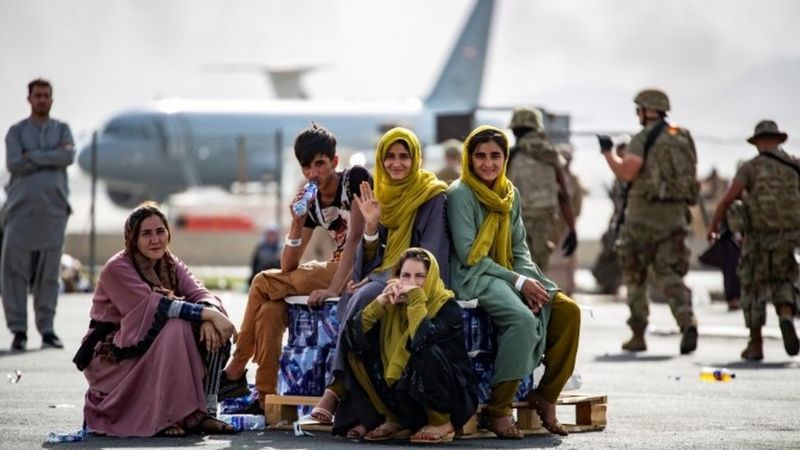
Afghans wave as they wait to board evacuation flights in Kabul

World leaders are getting ready for an important meeting to talk about Afghanistan and what’s happening there,

At the virtual meeting of the G7 groups of countries – which includes the UK, the US, Canada, France, Germany, Italy, Japan – leaders will discuss the situation and try to make a plan for now and for the future.

It follows the takeover of the Afghan capital Kabul by the Taliban, the withdrawal of US troops and refugees trying to flee the country.

Many thousands of refugees are crowded outside Kabul airport, desperate to leave.

After 20 years of conflict, the US says it intends to stick to its plan to pull all troops out of the country by the end of August.

23 agosto, 2021
por Felipe Sahagún
Sin comentarios

Data to report on conflict

 
by SHERRY RICCHIARDI
Jun 2, 2021 in DATA JOURNALISM

In a New York Times investigation into the Syrian government’s network of torture chambers, reporter Anne Barnard pointed to the important role data played in calculating the human toll.

“We redoubled efforts to cover the story, as human rights groups steadily compiled data on dozens of torture facilities, tens of thousands of disappeared Syrians and thousands of executions of civilian oppositionists after sham trials,” wrote Barnard, a former New York Times Beirut bureau chief and veteran of covering the armed conflict.

Her reporting noted: “Nearly 128,000 have never emerged, and are presumed to be either dead or still in custody, according to the Syrian Network for Human Rights, an independent monitoring group that keeps the most rigorous tally. Nearly 14,000 were `killed under torture.’”

Statistics on conflicts are widely available, but how do journalists identify the right datasets to use?  How do they evaluate data sources among the many out there? What should they be looking for?

“More data is not necessarily better data. We need to know where it is coming from, what is included and what is not. Reporters should not take all data as unbiased facts,” said Andreas Foro Tollefsen, senior researcher for the Peace Research Institute, Oslo, a main player in the conflict data field. 

Reviewing leading producers of conflict event datasets and their specialties helps narrow the search.  Below are three examples of data collection projects often cited in media reports and scholarly studies.

 
More fron ijnet

Sources on conflict

  • Uppsala Conflict Data Program (UCDP): Datasets on conflict and peacekeeping including peace agreements, intrastate armed conflict, non-state conflict, one-sided violence, and conflict termination. Offers datasets on organized violence and peacemaking, which can be downloaded for free through the UCDP downloads website. Illustrative charts, graphs, and maps are also available.
  • Armed Conflict Location & Event Dataset (ACLED): Described as a disaggregated data collection, analysis and crisis mapping platform. Collects real-time data on the locations, dates, actors, fatalities, and types of reported political violence and protest events across the globe. Users can explore data through an interactive dashboard. 
  • Peace Research Institute, Oslo (PRIO): Explores how conflicts erupt and can be resolved; investigates how different kinds of violence affect people and examines how societies tackle crises. Their data projects aid in the study of the duration of violence and track figures for yearly combat deaths. Active research projects are listed alphabetically and include dozens of topics.

 

23 agosto, 2021
por Felipe Sahagún
Sin comentarios

Think tanks’ impact on policy in a rapidly changing world (Foreign Policy Analytics)

COVID-19 Amplifies Global Threats to Democracy and Prosperity

Navigating Through Turbulence

The last few years have seen rises in authoritarianism, economic protectionism, poverty, and threats to human rights and civil liberties, trends that were all further exacerbated by the COVID-19 pandemic. Efforts to combat such trends take many forms, but this report is particularly concerned with the role and impact of think tanks given their capacity to understand, explain, and shape these trends. Such organizations have proliferated globally since the 1990s, but there has been limited research and a lack of consensus regarding how successful they are in counteracting these negative trends. To explore this topic, FP Analytics conducted an in-depth survey and semi-structured interviews with think tank personnel to highlight the experiences and viewpoints of the think tank staff working on the ground to advance democracy, economic openness, human rights, and poverty reduction in their home countries. Continue leyendo →

23 agosto, 2021
por Felipe Sahagún
Sin comentarios

Desinformación sobre Afganistán verificada por AFP

Elemento multimedia de encabezado

AFP Factual @AfpFactual
21 de agosto de 2021
El 15 de agosto, tras una ofensiva relámpago, los talibanes entraron en la capital de Afganistán y tomaron el palacio de gobierno, mientras el presidente Ashraf Ghani huía del país. Los hechos hicieron temer un retorno de la rigurosa interpretación de la sharia, la ley islámica, que ya impusieron durante su gobierno entre 1996 y 2001. Las imágenes del aeropuerto de Kabul, de civiles evacuados y del nuevo aspecto de las calles afganas impactaron al mundo. Pero no todas las fotos y videos divulgados muestran hechos recientes ni en Afganistán. Vea aquí los contenidos verificados por la #AFP 
 

22 agosto, 2021
por Felipe Sahagún
Sin comentarios

The Legacy of the U.S. War in Afghanistan in Nine Graphics (CFR)

The number of girls enrolled in primary school soared following the U.S. invasion in 2001.

The number of girls enrolled in primary school soared following the U.S. invasion in 2001. Javed Tanveer/AFP/Getty Images v @CFR_org

The U.S. overthrow of the Taliban regime after the 9/11 attacks ushered in a massive nation-building project. Nine graphics show what changed in Afghanistan over the past two decades.

August 17, 2021 2:25 pm (EST)

Since the U.S. invasion in 2001, Washington and its partners in the North Atlantic Treaty Organization (NATO) have spent hundreds of billions of dollars on Afghanistan’s reconstruction. They aimed to develop the country’s democracy, train security forces, build roads and hospitals, and expand rights for women and minority communities. Continue leyendo →