Relaciones Internacionales – Comunicación Internacional

25 febrero, 2026
por Felipe Sahagún
Sin comentarios

Ukraine, 4 years of war

2026-02-24T133009Z_863833124_MT1HNSLCS000JLQQO9_RTRMADP_3_HANS-LUCAS

Atlantic Council

Documenting how life in Ukraine has been reshaped by war, Odesa-based Atlantic Council fellow Michael Bociurkiw writes in The Globe and Mail that local businesses that withstood initial shocks are now closing, “worn down” by “uncertainty,” power outages, and low foot traffic with “men staying home to avoid military police seeking draft evaders.”

..MORE
Continue leyendo →

24 febrero, 2026
por Felipe Sahagún
Sin comentarios

Gender discrimination since 1979

CFR Education

This Women’s History Month, the Council on Foreign Relations is empowering educators to bring the global conversation on gender inequality into the classroom.

While progress toward equality is critical for women and girls, its impact reaches far beyond the individual. As experts have documented, gender equality comes with significant social and economic benefits.

In this newsletter, you will find: 

Happy learning,

Caroline Netchvolodoff 
Vice President, Education 
Council on Foreign Relations 

Continue leyendo →

22 febrero, 2026
por Felipe Sahagún
Sin comentarios

Reporters at risk (navigating Iran’s internet blakout)

On Friday, February 27, at 1:00 p.m. ET, the Atlantic Council’s Adrienne Arsht National Security Resilience Initiative and Scowcroft Middle East Security Initiative will host a “Reporters at Risk” event on journalists’ efforts to report on the recent Iranian protests.

It would be impossible to cover the 2025-2026 protests and the Iranian government’s repressive response, which led to at least five thousand deaths, without the information distributed within and outside Iran by correspondents facing a government-initiated internet shutdown.

This event in our “Reporters at Risk” series will feature experts and journalists who covered the Iranian protests discussing how correspondents have remained resilient while facing physical, psychological, and political threats and technological challenges and why it matters for US foreign policy.

New policy: In-person attendees will be required to show photo ID upon arrival, and no on-site registration will be permitted. Guests will not be admitted later than twenty minutes after the event’s start time. Registration for this event will close at 5:00 p.m. ET the day prior. 

…More

Related

Reporters at risk: How editors balance covering war with protecting journalists

Reporters at risk: In honor of Evan Gershkovich

Reporters at risk: On the frontlines in Ukraine and Gaza

Reporters at risk: Latin America and the Caribbean

Reporters at risk: Reflections on the Bosnian War, thirty years on

Reporters at risk: Supporting truth tellers in an age of rising authoritarianism


18 febrero, 2026
por Felipe Sahagún
Sin comentarios

Does Trump really care about peace in Ukraine? Not really… (The Guardian)

Volodymyr Zelenskyy says ‘no agreement’ has been made during Ukraine-Russia peace talks taking place in Geneva. The US are brokering talks but expectations remain low – while Ukrainians continue to face Russian strikes amid subzero temperatures. Lucy Hough speaks to the Guardian’s foreign correspondent in Kyiv, Luke Harding.


18 febrero, 2026
por Felipe Sahagún
Sin comentarios

The tightrope of reporting in Putin’s Russia

18 February 2026

Next week marks four years since the full-scale invasion of Ukraine. In that time, there’s been an intense crackdown on freedom of speech and dissent in Russia, which has led to many western media organisations leaving the country.

Today, we speak to Steve Rosenberg, the BBC’s Russia editor, on the tightrope of reporting from Moscow under Vladimir Putin.

Producer: Sam Chantarasak

Executive producer: Bridget Harney

Mix: Travis Evans

Senior news editor: China Collins

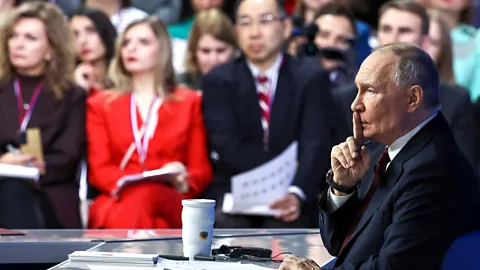
Photo: Russian President Vladimir Putin attends his annual end-of-year press conference in Moscow. Credit: Sputnik/Alexander Kazakov/Pool/Reuters.