Relaciones Internacionales – Comunicación Internacional

1 agosto, 2020
por Felipe Sahagún
Sin comentarios

Las tecnológicas, en el banquillo de los acusados

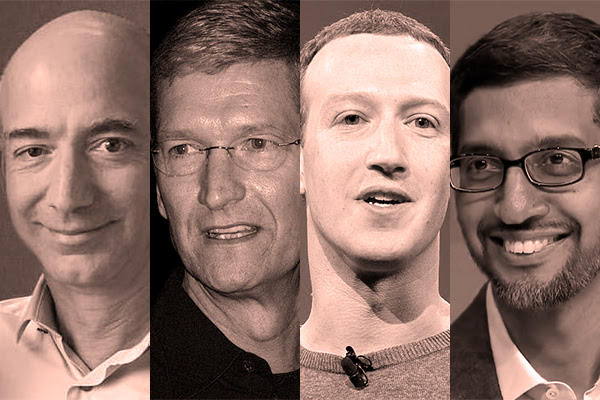
Los presidentes ejecutivos de las Big Tech Jeff Bezos (Amazon), Tim Cook (Apple), Mark Zuckerberg (Facebook) y Sundar Pichai (Google). Imagenes: Wikipedia Commons

Los presidentes ejecutivos de las Big Tech: Jeff Bezos (Amazon), Tim Cook (Apple), Mark Zuckerberg (Facebook) y Sundar Pichai (Google). Imagenes: Wikipedia Commons v @rielcano

Real Instituto Elcano

Nº 783. 29 de julio de 2020 · Publicaciones e información reciente de think tanks, institutos de investigación y organismos internacionales

Los presidentes ejecutivos de Apple, Amazon, Facebook y Google testifican conjuntamente ante el comité antimonopolio del Congreso de EEUU en el marco de una investigación sobre la posible supresión de la competencia por parte de las Big Tech que ha podido perjudicar a los consumidores y limitar a los rivales. Hace un año que se abrió dicha investigación tras una iniciativa respaldada tanto por el Partido Republicano como por el Partido Demócrata. Los estadounidenses muestran su preocupación por el papel que juegan en la sociedad Internet y las grandes compañías tecnológicas, que suman un valor de mercado de 4,85 billones de dólares. La comparecencia, que se ha calificado de espectáculo histórico, se ha comparado con la de las grandes tabacaleras en 1994, tras la cual se obligó al sector a pagar millones de dólares en daños y perjuicios.

Related

Quali sono le conseguenze per l’UE dopo la sentenza favorevole a Apple (Nicola Bilotta, Stefano Scolamiero. Affari Internazionali (IAI))


1 agosto, 2020
por Felipe Sahagún
Sin comentarios

US troop withdrawal from Germany (WPR)

U.S. Secretary of State Mike Pompeo talks to American soldiers based in Grafenwoehr, Germany

World Politics Review

Candace Rondeaux Friday, July 31, 2020

According to Washington’s punditocracy, there are only two ways to interpret the Pentagon’s announcement Wednesday that it plans to move ahead with withdrawing nearly 12,000 U.S. troops currently stationed in Germany. One view is that President Donald Trump is capitulating yet again to pressure from Russian President Vladimir Putin and handing Putin a gift in the form of a weakened NATO. The other take is that the White House decision to pull troops out of Germany, as Trump has long wanted, is a foolish escalation in his standoff with German Chancellor Angela Merkel over the future of the trans-Atlantic alliance. Continue leyendo →

31 julio, 2020
por Felipe Sahagún
Sin comentarios

When and how to let migrants move again

The Economist cover image for the Aug 1st 2020 edition

THE ECONOMIST, August 1, 2020

EVERY COUNTRY in the world has closed or partly closed its borders since the pandemic began. In total, they have issued more than 65,000 restrictions on mobility. For some places, especially islands, border controls have bought valuable time to prepare for covid-19. But the costs of global immobility are immense (see article). Billions of cancelled journeys means millions of jobs obliterated, lives blighted and dreams deferred. When bankers and tourists stopped flying to the United Arab Emirates (UAE), for example, the migrants who made beds and stirred soup were laid off. Foreigners without jobs are required to leave the Gulf, but lots of them cannot, because so many flights have been grounded. Globally, tens of millions of migrants have been stranded, burning through the savings they had hoped would lift their families out of poverty and put their children through school. Some have ended up begging; and since that is a crime in the UAE, several have been arrested.

Migration policy is far from the top of any country’s agenda just now. And with the coronavirus still raging, a return to normality will be impossible for some time. But governments will sooner or later have to grapple with an important question. As they gradually and fitfully open up again for tourists and business travellers, will they also welcome migrants?

…MORE

29 julio, 2020
por Felipe Sahagún
Sin comentarios

Después del orden internacional liberal (Joseph Nye)


José Antonio Sanahuja@JASanahuja
Economía política y orden internacional más fragmentados y globalización en crisis. La cuestión es cómo y con quién se trazarán las nuevas áreas de cooperación y discordia. Cuestión clave para la UE y sus ¿socios? en #AmericaLatina elpais.com/opinion/2020-0 via@el_pais
 
Related

29 julio, 2020
por Felipe Sahagún
Sin comentarios

What causes populism? (Michael Ignatieff)

What are the main causes of populism? Michael Ignatieff, President and Rector of the Central European University, talks about the global rise of populism, its causes and consequences.

VIDEO TRANSCRIPT

Michael Ignatieff: Populism is a movement in which you use democracy against democracy. The populists say: “We the people want to take back control from the elites who have corrupted the political system.” So it is a democratic argument used against the democratic system.

Sometimes it can enrich a democratic system to have a populist challenge. I don’t think populism is always a negative phenomenon. There is nothing wrong with the defence of your culture, your language and your identity. The problem comes when you want to use that defence to exclude others, to create an identity that shuts other people out.

But why do people turn to nationalism and populism? They do so to defend themselves, their families, their interests, these things that they hold to be important. I have never been someone who thought that populism was necessarily negative. It only becomes negative when it excludes, when it denies the rights of others. That’s when the question becomes serious.

…MORE