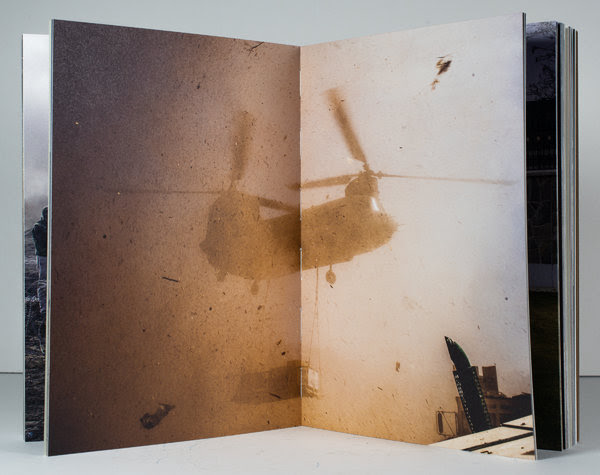
Anyone who has followed the conflicts the United States bundled together into the Pentagon’s Global War on Terrorism can be forgiven for wondering how the American military keeps its story straight. New developments on the ground often provide fresh or agonizing examples of official scripts no longer working. The fate of the Pentagon’s former Kurdish allies against the Islamic State — brothers and sisters-in-arms one day, abandoned to contend with their Turkish military and Islamist enemies the next — is the latest exhibit of how abruptly American story lines change and how official statements, in the face of the facts of official actions, can ring hollow. This tension, between the Pentagon’s public framing of its wars since 2001 and what actually occurred, is central in “Attention Servicemember,” a newly released book by Ben Brody, a former United States Army sergeant. Brody served two tours as an Army photographer during some of the most violent periods of American occupation. He’s long out of uniform now, and his book — more than 150 photographs and about 8,000 words of text — has the feel of an accidental propagandist reckoning with his own enlistment. Brody volunteered for the Army with misgivings, but he showed up in Iraq eager to make pictures, only to have what he documented airbrushed and fed into the government’s feel-good publicity machines. He recaps his tours with passages of riveting candor: «The doctrine was to photograph the war in a way that justified its existence and exaggerated its accomplishments. The visual doctrine wasn’t codified, but it was enforced. You learned what pictures the Public Affairs Officer would release and what he wouldn’t. Photograph the hospital opening, even though the Iraqi doctors had long fled and squatters were preparing to loot the new copper wires. Photograph the men being captured as though they were dangerous militants, when really they were just Sunni and targeted for sectarian reasons by the Iraqi Police. Photograph the bombs, the guns and the helicopters for all their ravenous beauty, but don’t photograph the obscenity of what they did to human bodies. Soldiers looking calm or stoic. Yes. Soldiers looking angry or frightened or exhausted or confused or lost or with eyes like the bottom of the ocean. No. My first tour I just photographed everything and let the PAOs figure out the censorship. My second tour I had a clearer sense of what was releasable and found I self-censored in a way I hadn’t before. The propaganda I produced was more convincing, and the pictures often grew legs and propagated across the internet in bizarre ways.” After leaving the military, Brody became a conflict photographer and settled in rural Massachusetts, where he wrestled with hyper-vigilance, dread, guilt and the uneven adaptations to civilian life that many veterans know. He also reverse-searched his body of work online and discovered that what is available had been appropriated kaleidoscopically. One image alone, of a captain he photographed between dashes in a gunfight after an air assault in December 2007, shows up repeatedly. “It’s decorative wallpaper, it’s patriotic, it’s a war crime, it’s disinformation,” he wrote. “It inspires hope and dread and purchases of cutting-edge tactical radio equipment. But when I see the picture I just smell the anise and the cordite. I feel the electric eels twisting in my guts and see the little girl screaming in the house that we finally broke into.” Brody was not an ideal soldier; he makes no such claim. His book describes how much pot he smoked in Iraq (about a quarter-pound, on one tour) and how his job as a public-relations specialist routinely let him roam between and within other units, largely unsupervised. He comes off as a tough young man who bristled under the Army’s authority but was fascinated and horrified by what he experienced, and committed to documenting what he could. He kept all the photographs he made on duty. “Attention Servicemember” is his effort to reclaim this work and share it with his own edit and in his own voice. It’s both a reminder of the power of the Pentagon’s public-relations engines to shape false impressions of the wars and a mini reckoning, not unlike what we see playing out on larger stages as the Global War on Terrorism’s incoherence serves up fresh heartbreak and confusion each season. Brody hopes veterans of these campaigns might recognize this grim repurposing, along with truths too ugly for government censors. Upon spending a few nights with his book, I decided to share it with readers of At War, many of whom might have crossed paths with Brody in Iraq, where with his government-issue cameras he ended up able to communicate in ways nothing like what the Army intended. Perhaps it will speak to you. “I know the photo art world is going to get into this book,” Brody said in a telephone interview this week. “But it’s much more important to me that it feels legit to the people who lived it.” C.J. Chivers is a long-form writer and investigative reporter who works for The New York Times Magazine and the Investigations Desk. His Pulitzer Prize-winning cover story for the magazine in 2016 led to the release from an Illinois prison of an Afghan war veteran suffering from post-traumatic stress disorder. |